

Professional Horror Prop Manufacturing Guide 2026
Last Updated: November 8, 2026
Quick Summary
Professional horror prop manufacturing is the end-to-end process of designing, sculpting, molding, casting, finishing, wiring, and testing a scare piece so it survives a full season of public use. Every professional build follows the same five-stage sequence, and skipping any stage shows up mid-season.
- The five stages are design and sculpt, build the base, mold and cast, paint and finish, then wire, test, and stress-check.
- A prop rated for indoor use will often fail outdoors within a single season.
- Ask vendors for real lead time, replacement controllers and motors, and outdoor-use ratings before ordering.
- The Horror Dome's 2026 animatronics collection reportedly spans nearly 200 products priced from roughly $160 to $4,400.
- Write a build sheet per SKU specifying materials, torque values, wire routing, paint layers, and test steps.
Table of Contents
- What Professional Horror Prop Manufacturing Actually Involves in 2026
- Materials That Survive a Full Season: Base Construction and Durability
- Horror Prop Casting, Painting, and Finishing: Where Realism Is Won
- How to Spot the Best Professional Halloween Animatronics
- Sourcing From Halloween Animatronic Companies Without Getting Burned
- Professional Haunted House Props: Safety, Compliance, and Season Logistics
- What It Costs and How to Scale Production Without Losing Quality
- Choosing Your Next Piece From Dr. Hyde's Laboratory
- Frequently Asked Questions
What Professional Horror Prop Manufacturing Actually Involves in 2026
Professional horror prop manufacturing is the end-to-end process of designing, sculpting, molding, casting, finishing, wiring, and testing a scare piece so it survives a full season of public use. Dr. Hyde's Laboratory offers a curated collection of unique Halloween costumes, horror props, and immersive decorations. The 2026 HD Studios Pro Mask Collection alone spans 10 designs across classic monsters, zombies, clowns, werewolves, and alien horror, according to The Horror Dome's 2026 collection announcement, and each one has to hold up night after night.
Most buyers assume a prop is a prop. It isn't. A $40 mask and a professional-grade creature share a silhouette and nothing else.
The Five Stages of a Build
Every professional horror prop manufacturing guide worth reading comes down to the same sequence:
- Design and sculpt the creature or character
- Build the base from foam, armature, or resin
- Mold and cast the shell
- Paint and finish the surface
- Wire, test, and stress-check the finished piece
Skip any stage and the prop fails in week three of a six-week run.
What Separates a Prop From a Professional Prop
A professional prop is built to be handled, stored, transported, and reused. A consumer prop is built to look right in a photo. The difference shows up in seam quality, paint adhesion, hinge durability, and whether the electronics survive a humid October night.
Every professional build follows the same five-stage sequence, and skipping any stage shows up mid-season.
| Stage | What to do |
|---|---|
| 1 | Design and sculpt the creature or character |
| 2 | Build the base from foam, armature, or resin |
| 3 | Mold and cast the shell |
| 4 | Paint and finish the surface |
| 5 | Wire, test, and stress-check the finished piece |
Materials That Survive a Full Season: Base Construction and Durability
Durability starts with the base, and the base material decides almost everything downstream: how the piece takes paint, how much it weighs on an actor or armature, how it fails, and whether it can be repaired on site at 6 p.m. on opening night.
Comparing the Core Materials
Metal armatures and frames are structural, not cosmetic. Aluminum keeps weight down and resists corrosion; steel is stronger and cheaper but needs coating to survive damp storage. Most professional builds combine materials: a foam body over an aluminum armature, a resin face on a latex hood, silicone skin on a foam core.
Matching Material to Environment
Watch out: a prop rated for indoor use will often fail outdoors within a single season, and the failure usually shows up in the electronics or the paint system before it shows up in the shell.
Repairability and Lifecycle
For wearable pieces, the Carnivore Full Face Ad Mask is a full-face latex mask with ventilation holes designed to keep the wearer comfortable.
Horror Prop Casting, Painting, and Finishing: Where Realism Is Won
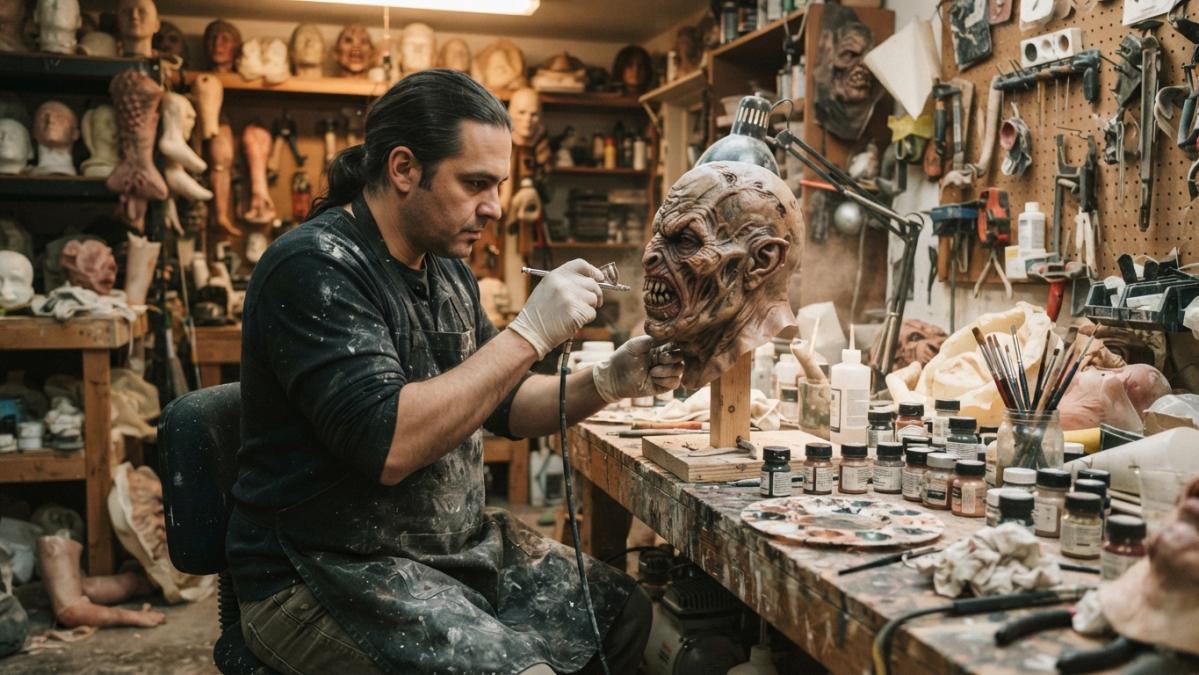
Realism is won in the finishing stages, not the sculpt. Two props can come out of the same mold and look nothing alike once the paint and surface detailing are done.
Casting the Shell
Casting captures the sculpt in a material that holds detail. Latex remains the standard for masks because it stretches, breathes, and takes layered paint well. Resin casting suits rigid creature parts and mechanical housings.
Paint and Surface Detailing
Our Carnivore Full Face Ad Mask features a creatively creepy, undead zombie design with recessed skin, sores, and a bloody nose detail.
How to Spot the Best Professional Halloween Animatronics
The best professional Halloween animatronics combine believable movement, reliable control hardware, and a build that survives repeated triggering. Movement quality separates a prop that startles once from one that works every time a guest walks past.
Mechanical Movement, Controllers, and Trigger Systems
Animated props rely on mechanical movement driven by controllers, and the trigger system decides how the scare lands. Wireless sensors and step pads let you place the activation exactly where the guest will be.
Our Step Here Pad is a simple 6 inch by 8 inch pressure pad that activates animated props through a mini jack connector on a 6-foot wire. It's the least glamorous part of a haunt and the one that determines whether the timing works.
Sourcing From Halloween Animatronic Companies Without Getting Burned
Ask three questions before you order:
- What is the real lead time, not the standard shipping time?
- Are replacement controllers and motors available?
- Is the prop rated for outdoor use, and what does the warranty exclude?
The Horror Dome's 2026 animatronics collection reportedly spans nearly 200 products priced from roughly $160 to $4,400, per the company's 2026 collection announcement. That range tells you the category is not one market. For a direct comparison of two animatronic suppliers, see how they stack up before you buy. A $160 piece and a $4,400 piece are built for different jobs.
Watch out: an electrically powered animatronic is not automatically suitable for outdoor use. Check the outdoor-use rating and plan for weather and theft protection before you commit a prop to an exterior display.
Professional Haunted House Props: Safety, Compliance, and Season Logistics
Plan the season in reverse. Work backward from opening night through testing, transport, installation, and rehearsal. Build in a buffer for at least one failed controller, because something always fails during tech week.
For attractions building custom pieces, our guide to custom horror props for haunted house attractions covers the planning side in more detail.
What It Costs and How to Scale Production Without Losing Quality
Cost scales faster than most operators expect, and it scales unevenly. The line items that grow with volume, materials, labor hours, electronics, shipping, and maintenance, behave differently from the ones that are fixed, molds, tooling, sculpting time, and design. A professional cost model separates the two and prices each unit against both.
Building a Unit Cost Model
A common pattern is that the visible materials are a minority of true unit cost once labor and rework are counted. Shops that price from materials alone underprice custom work and then discover the margin disappeared in finishing hours.
Standardize What Doesn't Scare
Repeatability is a manufacturing problem, not an artistic one. Write a build sheet per SKU that specifies materials, torque values, wire routing, paint layers, and test steps. A build sheet is what lets a second builder produce a piece that matches the first.
Batch Sizing, Lead Times, and Suppliers
Watch out: a vendor's quoted lead time is usually production time only, confirm the ship date in writing and build your season plan around the later of the two.
Pricing for Retail and Wholesale
Bizrate Insights surveyed 1,784 shoppers at checkout for its 2026 Halloween shopping trends report, which found budgets tightening even as interest in costumes and pop-up retail surges. Buyers are watching spend, which makes build quality per dollar the deciding factor, and makes an accurate cost model the difference between a profitable season and a busy one.
For the numbers behind premium pricing, our 2026 price breakdown on why artisan horror props cost more walks through where the money goes. If you're planning volume, scaling haunted house props without losing the scare covers the production sequence step by step.
Choosing Your Next Piece From Dr. Hyde's Laboratory
Start with the scare you want, then work backward to the prop. A jump-scare piece needs fast triggering and reliable movement. An atmospheric piece needs surface detail that holds up under close inspection.
Our catalog includes pieces like the Chainsaw Prop W/ Sound, which has a toggle switch that starts a motor idling sound effect, and a trigger that spins the chain with sound effects.
For performers building a full look, the Monster Make Up Book covers over 26 monster make-ups with 786 step-by-step photos, and the Makeup Crayons are a five-color pack that washes off with mild soap and water.
The difference between a display that gets remembered and one that gets walked past is build quality you can't see until week four. Dr. Hyde's Laboratory builds pieces around narrative and durability: unique non-conventional styles, experimental outputs that blur design and narrative, and fast shipping so your season doesn't slip. Browse the collection and find the piece that shifts the room.
Frequently Asked Questions
Where do haunted houses get their props?
Professional haunts often source props from specialist makers, and it helps to ask suppliers how each piece is built. Ordering early matters, so ask any supplier for a delivery date in writing before you commit your opening night. Ask any supplier for a delivery date in writing before you commit your opening night.
How can I tell whether a horror prop is built for professional use?
Look for three things: a stated material (latex, foam, resin, or metal frame), a documented control method for anything animated, and a clear answer on outdoor use. Props can look similar in a photo, so check the construction details before you buy. Ask how the piece is triggered, whether replacement parts exist, and what maintenance it needs. If a seller cannot answer those, the piece is decorative, not professional.
What materials are commonly used to make haunted house props?
Latex and EVA foam dominate masks and creature skins because they stretch, take paint well, and stay light enough to wear or hang. Resin and fiberglass handle rigid parts like claws and armor plates. Frames are usually steel, aluminum, or plywood, and animatronics add motors, controllers, and wireless sensors on top. Durability comes from how these are joined, not from any single material. A latex mask with hand-detailed paint and proper ventilation will outlast a cheaper cast every season.
How do I compare professional Halloween animatronics before buying?
Compare four specs side by side: trigger type, movement range, power requirements, and weather rating. The Step Here Pad at $12.99 is a 6 inch by 8 inch pressure pad with a 6-foot wire and mini jack connector for activating animated props. Check whether the motor is serviceable and whether the controller can be swapped. Then confirm the prop's outdoor-use rating before using it outside. Price alone tells you very little.
What maintenance do professional horror props and animatronics need?
Animatronics need a pre-season check of every moving joint, a test of each trigger, and a look at wiring for wear. Outdoor pieces need weather protection and a plan against theft, since a large prop left in a yard overnight is an easy target. Build a simple log: date, prop, issue, fix. That log turns guesswork into a maintenance schedule you can hand to staff.
How far in advance should I order props for a haunted house opening in six weeks?
Start now and split the order. Ask which category your piece falls into, and confirm the cutoff date for your opening night in writing. Confirm the cutoff date in writing, and keep a backup plan for any piece that slips.
