

Custom Horror Props for Haunted House Attractions
Table of Contents
- What Custom Horror Props Actually Deliver
- Professional Haunted House Props vs. Retail Decorations
- Haunted House Animatronics: What Moves and What It Costs
- Haunted House Prop Ideas That Hold a Scene Together
- Haunted House Prop Suppliers: How to Vet a Vendor
- Custom Prop Costs, Lead Times, and Budget Planning
- Safety, Durability, and Maintenance for Attraction Props
- Frequently Asked Questions
Last Updated: October 17, 2026
What Custom Horror Props Actually Deliver
Custom horror props for haunted house attractions are built-to-order pieces designed around a specific scene, sightline, or scare beat rather than sold off a shelf. At Dr. Hyde's Laboratory, we offer a curated collection of unique Halloween costumes, horror props, and immersive decorations designed to blur the boundary between design and narrative.
A retail skeleton is a decoration. A custom prop is a scripted moment: the doll that speaks when someone crosses the sensor, the coffin lid that lifts on cue.
Professional Haunted House Props vs. Retail Decorations
The split comes down to duty cycle, repairability, and crowd handling.
Retail decorations are built for a few weeks on a porch. Professional haunted house props are built for hundreds of activations a night, and the good ones come apart for service. Ask any operator what fails first: motors, wiring at the joint, and fabric that tears at the seam.
- Duty cycle: Retail props run on a timer. Attraction props run on triggers, all night.
- Repairability: Can you replace the motor or the sound board without scrapping the shell?
- Serviceability: Does the manufacturer publish instructions? The Animated Cracked Victorian Doll ships with a downloadable instruction sheet, which sounds small until something stops working in week three.
Haunted House Animatronics: What Moves and What It Costs
Haunted house animatronics are props with a powered action: a rise, a shake, a turn, a line of dialogue. Price tracks the number of movements and the trigger type, not size.

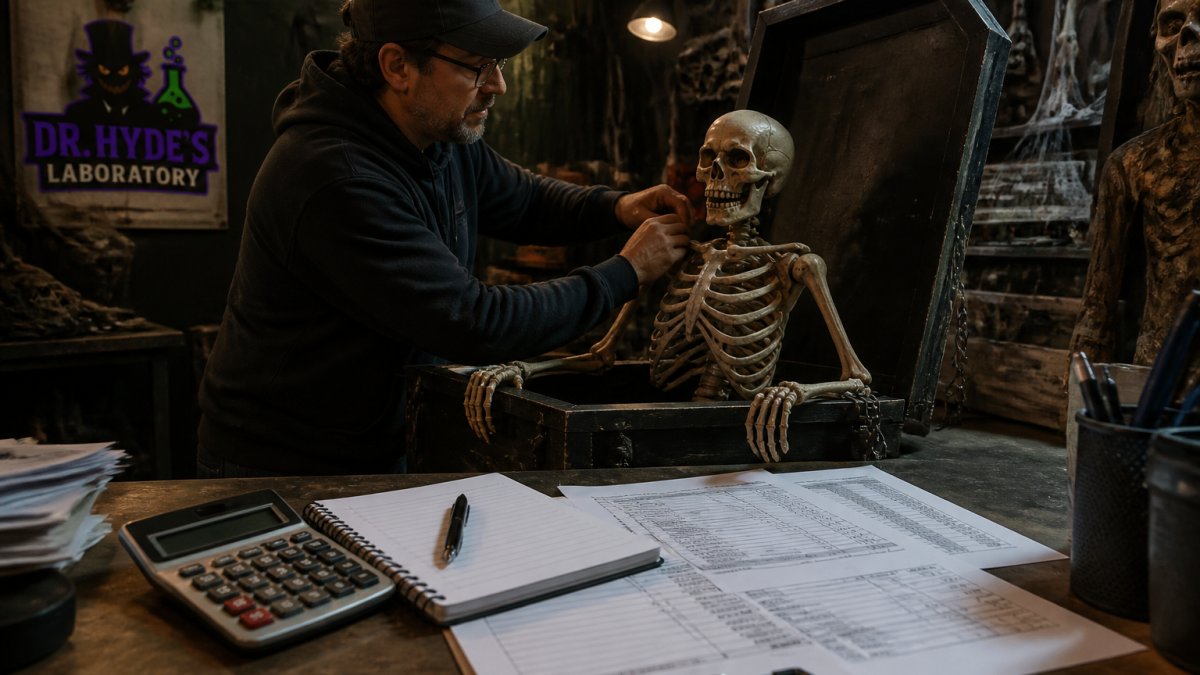
Our own range shows the spread. The 3 Ft Upside Down Animated Girl runs $45.99 for a hanging scare. The 47" Animated Rising Skeleton in Coffin sits at $180.99 for a full-body rise.

Static vs. Animated: Choosing the Right Trigger
Pick static props for atmosphere and animated props for the scare beat. A corridor of static figures with one animated piece at the end hits harder than five moving props competing for attention.
Trigger type decides how the scare lands:
- Motion sensor: fires on approach. Best for jump scares in tight spaces.
- Sound activated: fires on a scream or a footstep. Good for reactive scenes.
- Light sensor: fires on a lighting change. Best for synchronized blackout reveals.
The Animated Cracked Victorian Doll uses a motion/light sensor and says one of five phrases with each activation, variety that keeps a scene from going stale for repeat visitors.
Haunted House Prop Ideas That Hold a Scene Together
A scene works when every prop answers one question: what happened here? Build around a story beat, then add the scare.
Start with the anchor piece, the one object the room is about: a coffin, a hanging cage, a cracked doll on a chair. Everything else supports it. Our strongest anchors imply a narrative: the Animated Cracked Victorian Doll with her phrases, the skeleton mid-rise from the lid.
Layer in the small stuff that sells the story:
- Gore piles and barrel toppers for the aftermath beat
- Severed heads and tombstones for set dressing between scares
- Flickering candles and hanging cages for light and silhouette
Building Corridors, Facades, and Photo Ops
Corridors need rhythm: dark, light, dark, scare. Facades set expectations before guests enter, so put budget into the entrance. Photo ops need a prop that photographs well under phone flash: high contrast, clear silhouette.
A practical rule for attractions: design corridors at 4 to 5 feet wide, keep scares at eye level or below, and leave photo op pieces clear of the traffic path so guests can stop without blocking the line.
Haunted House Prop Suppliers: How to Vet a Vendor
Most ranking pages for this keyword are product listings or broad service pages. This section provides a procurement and commissioning checklist you can run against any vendor, catalog or custom.
The Custom Commissioning Process, Step by Step
A custom horror prop is a small fabrication project. Treat it like one and the surprises drop sharply.
- Define the concept in writing. Write a one-page brief: the scene, scare beat, sightline, guest path, trigger, target duty cycle (activations per night), dimensions, and mounting surface. A vendor who cannot work from a written brief may improvise, and improvisation can lead to lead times slipping.
- Share references, not just adjectives. Send photos of comparable props, sketches, and a short video of the motion you want. "Creepy" is not a spec; "a 12-inch rise over 1.5 seconds, then a 3-second hold, then a slow drop" is.
- Request a design approval before fabrication. Ask for a dimensioned drawing or foam-core mockup and approve it in writing. This is an effective point to catch a prop too large for the corridor or too small to read at 20 feet.
- Confirm the bill of materials. Ask what the frame, skin, motor, controller, and power supply are. A vendor who will not disclose materials may not support the piece later.
- Lock the fabrication and delivery schedule. Get dates in writing for design approval, fabrication start, pre-ship inspection photos, and ship date. Build in a buffer before your run opens.
- Approve pre-ship photos and a motion video. Ask for the prop running under its own power before it ships. This catches wiring and trigger faults while the piece is still in the shop.
Vendor Evaluation Checklist
Run this against every supplier, catalog or custom:
- Written lead time in days, not "ships fast"
- Design approval and pre-ship photo/video milestones in the contract
- Bill of materials disclosed (frame, skin, motor, controller, power)
It is important to consider after-sales support. Ask for images of the prop installed in an actual attraction. A vendor who cannot produce them may be selling catalog photography. Ask about support channels for issues like a motor stalling.
Fabrication Capability Questions
For custom work, go deeper than the catalog checklist:
Animated Cracked Victorian Doll →
- In-house versus outsourced: Ask which steps happen in-house (frame welding, sculpting, molding, electronics, finishing) and which are subcontracted. Outsourced electronics can be a source of lead-time slippage.
- Controller and trigger options: Confirm whether the prop supports motion, sound, light, or pressure-mat triggers, and whether triggers can be daisy-chained or offset. Ask for the control voltage and whether it runs on low-voltage DC or line voltage.
- Serviceability by design: Ask whether the motor and controller can be reached without destroying the skin, and whether fasteners are captive or reusable. A prop that must be cut open to service may need to be replaced.
Dr. Hyde's Laboratory publishes setup instructions for pieces like the Animated Cracked Victorian Doll and lists shipping restrictions on the product page, so you know before checkout whether a piece fits your build schedule.
Custom Prop Costs, Lead Times, and Budget Planning
Budget in three buckets: anchor pieces, filler props, and spares. Operators may overspend on filler and under-budget spares, which can lead to issues like a dead motor.
A workable split for a mid-size attraction looks like this:
| Budget Bucket | Share of Prop Spend | What It Covers |
|---|---|---|
| Anchor pieces | 50% | One or two hero props per room |
| Filler and set dressing | 30% | Tombstones, gore, candles, small figures |
| Spares and repair | 20% | Backup units, motors, batteries, fabric |
On lead times, treat six weeks as the working assumption for a custom or specialized piece and confirm in writing. Ground shipping is not rush production, and oversize animatronics often carry extra processing days regardless of freight.
Safety, Durability, and Maintenance for Attraction Props
Safety and durability are the same conversation in a working attraction. A prop that tips, overheats, or drops a piece onto a guest is a liability and a maintenance problem at once.
Fire and Electrical Safety
Anything that draws power in a public assembly space is subject to fire and electrical codes, which vary by building and municipality. Confirm with your local authority having jurisdiction before install, and plan for these common patterns:
- Power supplies: Follow the manufacturer's voltage and amperage requirements exactly. Using a higher-amperage adapter can be a cause of controller failure and a fire risk.
- Circuit loading: Do not daisy-chain multiple animatronics onto one household circuit. Add up the rated draw and keep the load within the circuit's capacity, with headroom for startup surge.
- Cords and connections: Route cords out of guest reach and walkways. Use cord covers or conduit anywhere a guest can touch, and strain-relieve every connection at the prop.
The OSHA guidance on walking-working surfaces is a useful starting reference for trip and fall hazards in guest areas, and NFPA 101 Life Safety Code is the standard most local fire officials reference for assembly occupancies. Your AHJ has the final word.
Structural and Guest-Safety Basics
- Hanging pieces: Secure to structure, never to drywall alone. Use rated hardware and a safety cable as a backup on any piece over head height.
- Tip hazards: Base-weight or anchor tall standing props. A 5-foot figure that a guest brushes past must not tip into the path.
- Sharp edges and protrusions: Sand or cover any edge at guest height. Actor weapons should be foam or rubber in guest-facing scenes.
Durability: Materials and Duty Cycle
Duty cycle drives material choice. A prop running 200 activations a night for 30 nights is a different engineering problem than a porch decoration.
- Frames: Welded steel or heavy-gauge aluminum for load-bearing motion; wood and PVC for static set dressing.
- Skins: Flexible foam and fabric for pieces that deform; rigid resin or fiberglass for pieces that must hold shape. Fabric at seams can be a failure point, so specifying reinforced seams and a repair kit can be beneficial.
- Motors and controllers: Ask for the rated duty cycle and buy one spare of each wear item at order time. Motors, belts, and fabric panels are the usual suspects.
Nightly and Seasonal Maintenance
Nightly maintenance takes minutes if you build the habit:
- Power on every animated piece and trigger it manually
- Check fabric seams and joints for tears or looseness
- Swap batteries on any piece that ran the full night
- Wipe sensors clean, since dust kills motion triggers
- Log any piece that misfired so you catch the pattern
Seasonal maintenance protects next year's budget:
- Pre-season: Full power-on test of every piece, torque check on all hanging hardware, and a visual inspection of every cord and connection.
- Mid-season: Pull and inspect the highest-duty pieces, replace wear items, and re-tension any fabric that has stretched.
- Post-season: Clean sensors and lenses, remove batteries, cover breathable, and log every failure for the repair plan.
Frequently Asked Questions
What props do professional haunted houses use?
Professional attractions build scenes from a mix of animated figures, static set pieces, and actor gear. Animatronics handle the timed scares, while facades, corridors, hanging cages, tombstones, and gore piles create the environment. Lighting, sound effects, and fog tie the room together. The strongest haunts layer a static prop, a motion-triggered piece, and a live actor in the same scene, so guests never learn the pattern. Budget usually goes first to pieces guests walk past slowly, since those get the most viewing time.
Are custom horror props worth the investment for a haunted attraction?
It depends on how long you plan to run. A $180.99 animated rising skeleton or a $137.99 crouching monster gets reused across multiple seasons, which spreads the cost. Custom pieces cost more upfront but let you build a scene no competitor nearby can copy, and that difference is what guests talk about. If you run a single weekend event, retail props may be enough. If you operate a ticketed attraction, custom horror props pay back through repeat visits and word of mouth.
How do you choose props for a haunted house attraction?
Start with the guest path, not the catalog. Walk your route and mark where guests slow down, turn, or wait. Those are the spots for haunted house animatronics and hero props. Fill long corridors with cheaper static pieces and lighting so attention stays on the big moments. Match each prop to a trigger type: motion, sound, or manual. Finally, check power and battery access before buying, since a prop you cannot reach to service becomes dead weight mid-season.
What materials are best for durable haunted house props?
Polyester and plastic bodies dominate mid-range animated props because they stay light enough to hang or mount and survive a season of bumping. For pieces guests touch or brush past, look for reinforced frames and sealed electronics. Fabric components collect dust and moisture, so store them dry and off the floor. Anything outdoors needs UV-resistant paint and drainage. Ask haunted house prop suppliers what the frame is made of, not just the exterior, because the frame decides whether the piece survives a second October.
How do you make animatronics safe for a haunted attraction?
Keep moving props out of the guest walkway or behind a physical barrier. Secure hanging figures like an upside-down animated girl with rated hardware, not zip ties, and check anchors weekly. Route cords under mats or overhead so nobody trips. Battery compartments should be screw-secured and out of reach. Confirm your local fire marshal's rules on flame retardancy and exit clearance before opening, and post clear warnings at any strobe or sudden-motion effect.
Where can haunted attractions buy custom horror props?
Specialty Halloween retailers and prop studios sell both catalog pieces and made-to-order work. Compare haunted house prop suppliers on three things: whether they publish real dimensions and materials, whether they show the piece running in an actual attraction, and how fast they ship. A 32-inch animated cracked Victorian doll at $79.99 ships as a standalone item, so confirm processing time before you book opening night. Order one piece first as a test before committing a full scene budget.
What is the difference between a static prop and an animatronic?
A static prop stays still and relies on placement, lighting, and actor timing to land the scare. An animatronic moves, usually triggered by motion, sound, or a button, and often adds speech or light. Static pieces cost less and never break mid-scene. Animatronics cost more and need battery changes, but they deliver the jump that guests remember. Most strong attractions use both: static props set the atmosphere, and haunted house animatronics deliver the payoff at the moment guests relax.
Building a haunt that actually scares people takes more than a catalog order. It takes props with timing, a scene that tells a story, and pieces that survive a full season of crowds. Dr. Hyde's Laboratory builds experimental props and animatronics for operators who want immersion rather than decoration, from sensor-triggered talking dolls to full coffin rises, with fast shipping and setup instructions included. Continue shopping and find the piece that anchors your next room.