

Why Artisan Horror Props Cost More: 2026 Price Breakdown
Table of Contents
- The Real Cost Drivers Behind Artisan Horror Props
- Handmade Horror Prop Materials and the Curing Process
- Labor, Sculpting, and the Artist's Hourly Rate
- Custom Animatronic Horror Prop Pricing Explained
- How to Care for Silicone Horror Masks and Preserve Your Investment
- Shipping, Fragile Handling, and the True Cost of Delivery
- Conclusion: Why Artisan Horror Props Are Worth the Premium
- Frequently Asked Questions
Last Updated: September 28, 2026
The Real Cost Drivers Behind Artisan Horror Props
Walk through any big-box Halloween aisle and you'll see a mass-produced mask for the price of lunch. Then you'll see a handmade piece listed at ten or twenty times that. The gap isn't marketing. Understanding why artisan horror props cost more comes down to four expenses that mass-market factories have engineered away: material quality, tooling, labor, and fragile shipping.
Dr. Hyde's Laboratory has spent years curating pieces that blur the line between design and narrative, and the pricing behind them follows a logic most shoppers never see. Below, we'll break down each cost driver, from raw silicone to the artist's hourly rate, so you can judge for yourself whether the premium is worth it.
Artisan horror props are handcrafted horror pieces produced in small batches by individual makers or small studios, rather than stamped out on high-volume assembly lines. That single distinction explains almost every price difference you'll encounter.
Handmade Horror Prop Materials and the Curing Process
Material choice is the first and largest cost multiplier. A factory mask might use thin, rigid plastic or a low-grade latex slip. A handmade horror prop materials list typically includes platinum-cure silicone, slip latex, or polyurethane resin, and each behaves differently under stress, and each carries a very different price per pound.
Silicone, Latex, and Polyurethane Resin: Why Material Choice Matters
Most practitioners find the raw-material spread looks roughly like this:
- Slip latex is the cheapest option by volume. It air-cures, stays flexible, and is forgiving to pour. The trade-off is real: latex degrades with UV exposure, skin oils, and repeated stretching, and it can develop a tacky surface over time. A latex mask that lives on a shelf in a climate-controlled room can last years; one worn to a humid outdoor haunt every weekend may show cracking within a single season.
- Platinum-cure silicone is the premium tier. It holds lifelike texture, resists tearing, and does not shrink appreciably as it cures, which means the mold detail transfers cleanly. It is also the most expensive per pound and the least forgiving, sulfur, tin, or latex contamination in the workspace can inhibit the cure and ruin an entire pour. That failure risk is baked into the price.
- Polyurethane resin gives structural integrity to rigid pieces like animatronic housings, prop weapons, and display bases. It cures hard and fast, takes paint well, and can be cast with metal powders or fillers for weight and finish. It is also brittle under impact and requires proper ventilation during pouring.
The Curing Process Is Where Cheap Batches Die
Curing is not a passive step. Platinum-cure silicone typically needs a controlled environment, stable temperature, low humidity, and a clean surface, and a full cure can take 24 hours or more per pour depending on mass and catalyst ratio. A rushed cure produces a gummy, weak, or unevenly cured piece that cannot be sold. A factory running thousands of units can absorb a bad batch; a small studio pouring six masks cannot.

Resin behaves similarly. Exothermic cure means a thick pour can generate enough heat to crack or discolor, so artisans pour in thin layers or use vacuum degassing to pull trapped air. Every one of those steps adds hours, equipment, and floor space, and floor space is a fixed cost that a small shop spreads across far fewer units than a factory.
Tooling and Mold Costs: The Hidden Expense
Every design needs a master mold before a single unit ships. Sculpting that master can take days, and the mold itself has a limited lifespan before detail degrades, silicone molds may yield only a few dozen pulls before fine texture softens, and resin or plaster molds can fail sooner under heat and release-agent wear.
A factory spreads this cost across tens of thousands of units, so the per-piece tooling charge is pennies. A small-batch producer spreads it across dozens, so the same mold might add tens of dollars to every unit. That is the hidden math behind the sticker price, and it is the expense most buyers never consider.
Labor, Sculpting, and the Artist's Hourly Rate
Here is the calculation that separates craft from commodity, and it is the calculation almost no competitor article actually shows you.
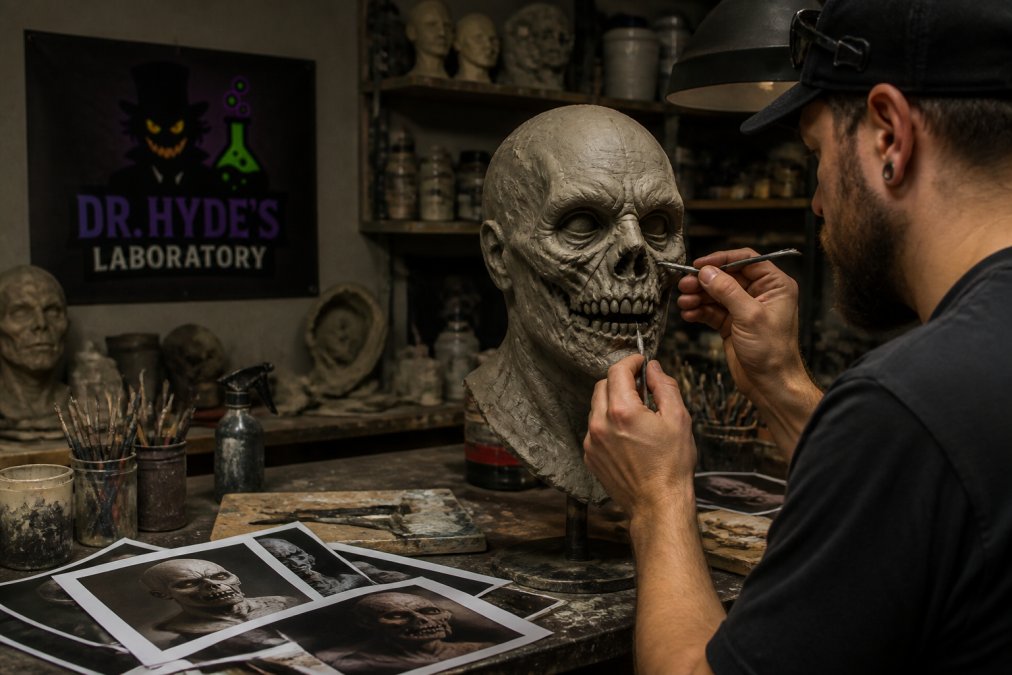
The Hours Behind a Single Piece
A bespoke sculpting project can consume 20 to 40 hours before molding even begins. That window covers armature building, blocking out the primary forms, refining secondary and tertiary detail, and surface texturing. A common pattern in small studios looks like this:
- Concept and reference: 2-5 hours
- Armature and rough block-out: 4-8 hours
- Detail sculpting and texture: 10-20 hours
- Mold making and casting: 4-8 hours
- Seam cleanup, priming, and base coat: 2-4 hours
- Hand-painted finish, washes, and sealing: 4-10 hours
That is a realistic 26-55 hour range for a single finished piece, and it does not include drying time between stages. A factory mask is demolded, trimmed, and painted by machine or by a line worker in minutes per unit.
Clown Latex Mask W/ Blue Hair →
What the Artist's Hourly Rate Actually Means
If an artist values their time at a professional rate, the kind of rate a freelance sculptor or prop fabricator would charge for commission work, the labor alone on a 40-hour piece often exceeds the final retail price of a mass-market alternative. That is the fair comparison: hours of artistic expertise versus minutes of machine time.
A common mistake buyers make is comparing a handmade piece to a retail mask on price alone. The retail mask has no artist attached to it.
Why Finishing Is the Most Underrated Labor Cost
Finishing techniques are where the hours quietly pile up. A hand-painted finish is not one coat of paint, it is layered washes, dry brushing, airbrush gradients, and sealing, often with curing time between each stage. A factory uses a single molded-in color or a machine-applied spray. The difference in appearance is not subtle, and the difference in labor is measured in hours, not minutes.
The Value of Artistic Skill and Experience
Experience compresses hours but raises the rate. A first-year sculptor might take 60 hours to reach a result a 15-year veteran achieves in 25, but the veteran's rate is higher because the outcome is more reliable. Either way, the buyer is paying for judgment: knowing when a form is right, when a cure is done, and when a paint layer needs one more pass.
Custom Animatronic Horror Prop Pricing Explained
Custom animatronic horror prop pricing climbs fastest of all. Animatronics combine sculpted shells, internal mechanisms, and electronics, and each component adds a failure point that requires testing.
| Cost Driver | Mass-Market Approach | Artisan Approach |
|---|---|---|
| Materials | Thin plastic, short-life latex | Silicone, resin, quality latex |
| Tooling | Spread over thousands of units | Spread over dozens |
| Labor | Assembly line, minutes per unit | Hand-sculpted, hours per unit |
| Finishing | Machine-applied paint | Hand-painted finish |
| Shipping | Bulk pallets | Individually packed, fragile |
How to Care for Silicone Horror Masks and Preserve Your Investment
Knowing how to care for silicone horror masks protects the money you spent. Silicone is durable, but it still reacts to prolonged sun, heat, and harsh solvents.
- Store masks stuffed with soft material to hold their shape
- Keep pieces out of direct sunlight to prevent color fade
- Clean with mild soap and water, never alcohol-based solvents
- Store latex separately from silicone to avoid material transfer
- Handle painted surfaces by the edges, not the finished detail
Shipping, Fragile Handling, and the True Cost of Delivery
Fragile shipping is a line item most buyers never see until checkout. A handmade mask or animatronic can't be tossed in a poly bag. It needs custom foam, a rigid box, and often double-boxing to survive transit.
Conclusion: Why Artisan Horror Props Are Worth the Premium
The honest answer to why artisan horror props cost more is that you're paying for materials that last, tooling that no factory amortizes for you, and hours of artistic expertise you can't replicate on a machine. Whether that's worth it depends on what you need the piece to do.
Frequently Asked Questions
What materials are used in high-end artisan horror props?
High-end artisan horror props typically use silicone, latex, polyurethane resin, and sometimes fiberglass or foam. Silicone offers lifelike texture and durability, while latex provides flexibility for wearable masks. Polyurethane resin is used for structural pieces like animatronic frames. These materials cost more than mass-market plastics but allow for high-fidelity details, hand-painted finishes, and long-term display quality.
Are artisan horror props more durable than store-bought decorations?
Yes, artisan horror props are generally more durable because they use thicker silicone, reinforced seams, and quality paints that resist cracking. Mass-produced items often use thin plastic and cheap paint that fades or peels. With proper care, like storing silicone masks away from direct sunlight, an artisan piece can last for years as a collectible or display item.
Why do independent horror artists charge more than big-box retailers?
Independent artists charge more because they make small-batch or one-of-a-kind pieces, not thousands of units. Their pricing covers raw materials, sculpting time, mold-making, hand-painting, and the artist's hourly rate. Big-box retailers rely on mass production overseas, which lowers costs but also reduces detail and durability. You pay for artistic expertise, custom fabrication, and a piece that stands out.
How does custom animatronic horror prop pricing work?
Custom animatronic horror prop pricing depends on complexity: number of movements, control system, materials, and design time. A simple pop-up mechanism costs less than a multi-axis figure with sound and lighting. Artists quote based on hours for design, fabrication, and testing, plus parts. Expect a range from a few hundred to several thousand dollars, with bespoke design fees factored in.