

How Do You Style a Dark Gothic Room Without It Feeling Gloomy?
Last Updated: November 1, 2026
Quick Summary
Style a dark gothic room with a three-tone palette: a dominant dark base, a mid-tone for depth, and a warm glow accent at roughly 10% to keep it from reading as a cave. Layer texture and use dimmable warm lighting in three layers so shadows stay alive.
- Follow the three-tone rule: 60% base, 30% depth, and 10% glow accents.
- Balance dark walls with lighter accents like cream throws and pale artwork.
- Build lighting in three layers: ambient, task, and accent, all dimmable warm white.
- Paint the ceiling the same dark tone as the walls to make small rooms feel larger.
- Fund lighting and texture first before buying statement pieces on a budget.
Table of Contents
- Start With a Gothic Color Palette, Not Just Black
- How to Apply Gothic Interior Design Principles to Real Rooms
- Layer Textures and Materials Before You Add More Color
- Moody Room Lighting Ideas That Keep the Shadows Alive
- Dark Gothic Room Ideas for Small or Low-Light Spaces
- Furniture, Finishes, and Antique Brass Details That Ground the Room
- Renter-Friendly and Budget-Conscious Ways to Go Gothic
- Build Your Immersive Gothic Space Piece by Piece
- Frequently Asked Questions
Start With a Gothic Color Palette, Not Just Black
The fastest way to make a dark room feel gloomy is to paint everything black and call it done. A gothic color palette works when it has range: a deep base, a mid-tone for depth, and a warm accent that gives the eye somewhere to land.
All-black rooms swallow light and detail. The fix is a three-tone structure, and it is the foundation for every other tip for styling dark gothic spaces in this guide.
The Three-Tone Rule: Base, Depth, and Glow
The three-tone rule is a color strategy that pairs one dominant dark base with a mid-tone and a warm accent. Base colors cover the largest surface: charcoal, slate gray, deep forest green, or blackened plum. Depth colors add structure: burgundy, oxblood, or dark wood brown on trim and furniture.
- Base (60%): walls, large rugs, upholstery
- Depth (30%): trim, doors, case goods, drapes
- Glow (10%): brass, candlelight, cream ceramics, warm metallics
That 10% is what keeps a room from reading as a cave. Skip it and the whole palette collapses into shadow.
How to Apply Gothic Interior Design Principles to Real Rooms
Gothic interior design borrows from Victorian and Baroque sources but rarely works when copied literally. The practical move is to take the drama and leave the clutter. Historical inspiration gives you pointed arches, heavy drapes, and dark wood.
Pick one or two historical gestures per room. A single arched mirror. One heavy drape. A carved mantel. Then let modern pieces do the rest.
Balance Dark Walls With Lighter Accents
Dark walls need lighter accents or they flatten out. This is the single most useful rule in dark interior design, and it costs almost nothing to apply.
- Add a cream or bone-colored throw to a charcoal sofa
- Hang pale artwork against a black wall
- Use a light stone or marble side table
The contrast does the work. A room with dark walls and zero lighter accents gives the eye nothing to measure the darkness against.
Layer Textures and Materials Before You Add More Color
Texture is what separates a rich gothic interior from a flat one. If a room feels lifeless, the problem is usually material, not color.
Layering means stacking materials with different surface qualities: matte against sheen, rough against smooth, soft against hard. Black lace over a stone wall.
- Stone and plaster: matte, cool, architectural
- Dark wood: warm, grained, grounding
- Dark metals: iron, pewter, blackened steel
Patina finishes matter more than most guides admit. A new brass fixture reads bright and modern.
Moody Room Lighting Ideas That Keep the Shadows Alive
Moody room lighting ideas fail when they try to light the whole room evenly. Gothic spaces need shadows. The goal is pools of warm light with darkness between them.
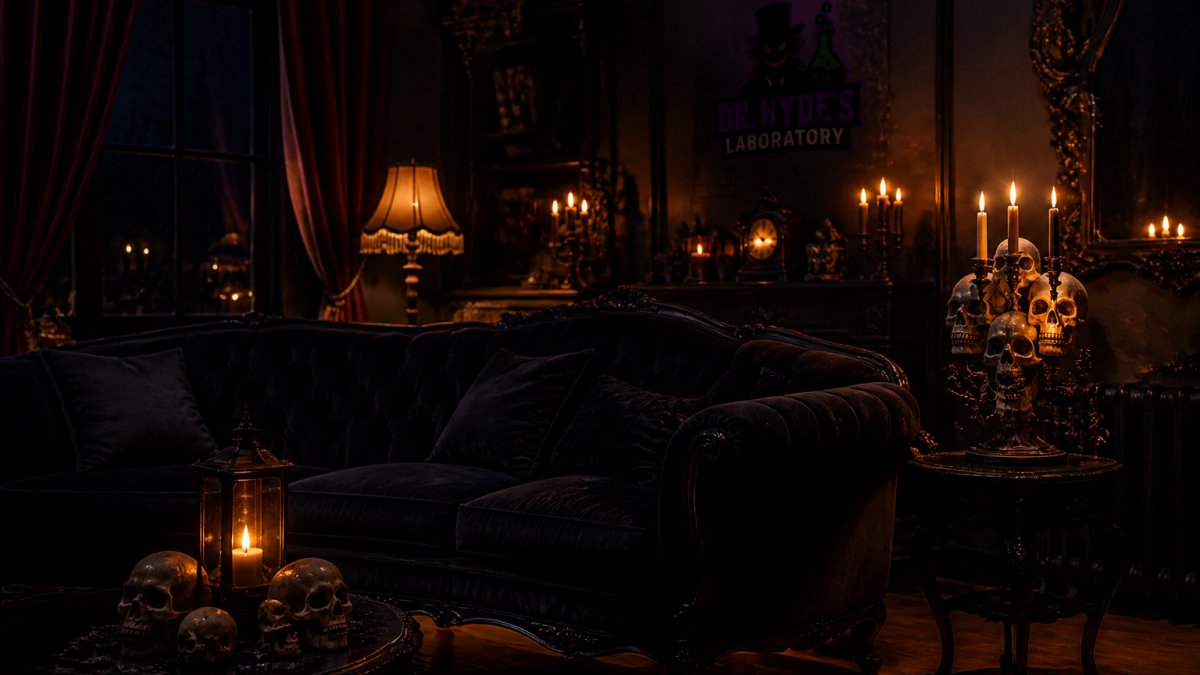
A Practical Three-Layer Lighting Plan
A three-layer lighting plan uses ambient, task, and accent light together so a dark room stays readable without going flat. Here is how we would build it:
- Ambient layer: one dimmable overhead or floor lamp at low output, warm white bulbs
- Task layer: a reading lamp or two at hip or table height
- Accent layer: candle-style lights, string lights, or uplights aimed at texture
Use dimmable bulbs everywhere. Warm white light, not cool white, keeps the mood. Spread light sources across the room so no single bulb has to carry it.
For the accent layer, a purple LED string set adds a sinister glow that reads as atmosphere rather than illumination. The LED Light Set 60 Light Purple runs 16 feet and works indoors or out.

Dark Gothic Room Ideas for Small or Low-Light Spaces
Small rooms and rooms with little natural light need the opposite of what most people assume. You do not fight the darkness. You lean into it and control where light lands. The goal is a room that reads as intentional shadow, not as a room that failed to get enough sun.
Treat Low Natural Light as a Feature
A basement, a north-facing bedroom, or a rental with one small window already has half the mood. Your job is adding warmth and reflection, not brightness. Overcorrecting with cool white light can flatten the palette and make dark paint look gray and chalky.
- Keep the dark base on all four walls and the ceiling so the room reads as one continuous volume
- Add warm light at low output rather than bright light at high output
- Introduce one reflective surface per sightline so the eye has something to catch
Control Visual Scale
Dark color does not automatically shrink a room, but heavy contrast at the edges does. Blur the room's boundaries and it feels larger.
- Paint the ceiling the same dark tone as the walls. A dark ceiling removes the bright lid that makes a small room feel capped.
- Run the base color onto the trim and doors. White trim against black walls draws a hard outline around every opening and makes the room feel boxed in.
- Keep furniture low and leggy. Visible floor space reads as square footage. A low sofa on tapered legs does more for a small gothic room than a tall tufted piece against the wall.
Use Reflection Deliberately
Mirrors and reflective finishes are the cheapest way to multiply the light you already have. Place a mirror opposite the window or opposite your main lamp so it bounces warm light back into the room rather than reflecting a dark corner.
- An antique brass or aged mirror frame adds patina and reflection in one piece
- A dark glass or polished stone side table catches lamp light without introducing a light color
- Mercury glass candle holders and dark metallics scatter small pools of light across a shelf
Avoid a wall of mirrors in a small gothic room. One well-placed mirror reads as a design choice; several read as a gym.
Rethink Window Treatments
Heavy blackout drapes are the default gothic move, but in a low-light room they can seal off the only daylight you have. A common pattern is to layer: a dark lace or sheer panel closest to the glass to filter and soften light, with heavier drapes on the sides that you can close at night.
- Dark lace lets some light through while keeping the gothic texture
- Hang drapes high and wide so the window reads larger than it is
- Use a tension rod in a rental so the treatment is reversible
A Simple Small-Room Lighting Plan
In a small room, fewer fixtures at lower output beat one bright overhead. Aim for three warm sources at different heights:
- A dimmable floor lamp in a corner at low output
- A table lamp or candle-style fixture at hip or table height
- An accent source, such as an uplight aimed at texture or a small string set, to add depth
Warm white bulbs throughout, dimmed as low as the room allows. The shadows between the pools of light are what make the room feel gothic rather than merely dark.
Furniture, Finishes, and Antique Brass Details That Ground the Room
A gothic room needs weight at the bottom. Furniture in dark wood or dark metals anchors the space so the drama above it has something to sit on.
Look for pieces with visible grain, turned legs, or carved detail. Soft wood tones work as a counterpoint when the walls are black.
Sculptural accents finish the job. A Skeleton Bust with a light glowing up from its base makes a strong shelf or mantel anchor. For candlelight with real presence, the 3-IN-1 Skull Candelabra stands 60 inches tall, hangs as a chandelier, or sits flat on a table, with four skulls and flickering LED candles.

Best for: readers grounding a room with metal, candlelight, and sculptural detail.
Renter-Friendly and Budget-Conscious Ways to Go Gothic
Renters can get most of the way to a gothic room without touching a wall. The trick is to treat removable pieces as your base coat and to spend in the order that changes the mood fastest. A prioritized plan keeps you from buying decor that fights the room you already have.
Spend in This Order
Lighting and texture carry much of the mood, while paint and furniture carry the structure. If you are building on a budget, fund the mood first.
- Lighting. Dimmable warm bulbs and two or three freestanding lamps do more for a dark room than any single decorative piece. This is where the first dollars should go.
- Texture. Throws, slipcovers, lace panels, and a textured rug soften a rental's flat surfaces and add the layered feel gothic rooms need.
- Removable wall treatment. Peel-and-stick wallpaper, removable wall art, and tapestries change the envelope without a lease violation.
- Statement pieces. Sculptural accents and candelabras come last, once the room already reads as gothic.
Reversible Options and Their Trade-Offs
- Peel-and-stick wallpaper in a dark damask or black lace pattern is the fastest way to a dark envelope, but adhesion varies by wall finish. Test a small strip on an inconspicuous area first, and avoid freshly painted walls, which can release the adhesive.
- Tension rods for drapes and tapestries need no drilling, but they rely on a solid window frame or doorway to grip. Measure the opening before you buy.
- Removable wall art and glow-in-the-dark decor are low-risk and easy to reposition, which makes them good for renters who rearrange often.
What to Skip on a Rental Budget
Skip anything that requires drilling, hardwiring, or permanent adhesive unless your lease allows it. Skip large furniture purchases until the lighting and texture are in place, because a dark sofa in a badly lit room still reads as a dark sofa in a badly lit room. And skip cool white bulbs entirely; they undo the warmth that the rest of the budget is buying.
A Low-Cost Starting Point
If you want to add glow and gothic wall art in one step, our Trick R Treat Glow in the Dark Wall Decor set is a low-cost, removable option. Pair it with a dimmable floor lamp and a dark lace panel, and you have the first layer of a gothic room without touching a wall.

If you are building on a budget, fund the mood first in this order.
| Priority | What to spend on | Why it comes here |
|---|---|---|
| 1 | Lighting: dimmable warm bulbs and two or three freestanding lamps | Does more for a dark room than any single decorative piece |
| 2 | Texture: throws, slipcovers, lace panels, textured rug | Softens flat rental surfaces and adds layered feel |
| 3 | Removable wall treatment: peel-and-stick wallpaper, removable art, tapestries | Changes the envelope without a lease violation |
| 4 | Statement pieces: sculptural accents and candelabras | Comes last, once the room already reads as gothic |
Build Your Immersive Gothic Space Piece by Piece
The best gothic rooms are assembled, not bought in one trip. Start with the palette, then lighting, then texture, then the statement pieces.
If you want the reasoning behind handmade pieces, read why handmade horror decor pieces are worth choosing. And if you want the room to tell a story rather than just look dark, our guide to creating narrative-driven horror decor goes deeper.
A dark gothic room takes nerve. Most people stop at the paint and wonder why it feels cold.
That is what we build at Dr.
Get started with Dr. Hyde's Laboratory and turn your dark room into a space that feels alive after sunset.
Frequently Asked Questions
How do you decorate a dark gothic room without making it feel gloomy?
The fix is contrast and light layering, not more color. Keep your dark gothic walls, then add at least three separate warm light sources at different heights so the eye has somewhere to travel. Mix in lighter accents such as aged brass, soft wood tones, or a pale stone object, and vary texture with drapes, tapestries, and black lace. A room reads gloomy when it has one flat light source and no reflective surfaces. Break both and the same dark palette feels intentional and cozy.
What colors work best in a gothic color palette?
Build around a deep base of black, slate gray, or forest green, then add one saturated accent like burgundy for warmth. A third, lighter tone keeps the room from collapsing into a single dark mass, so bring in stone, aged brass, or soft wood tones through furniture and accessories. Modern gothic rooms often swap one traditional color for a contemporary accent, which keeps the historical inspiration visible without turning the space into a period set.
What lighting works best for a dark gothic space?
Use several low-output, warm white light sources instead of one bright overhead fixture. Dimmable bulbs in lamps, candles, and string lights let you push the room toward a moody atmosphere for evenings and dial it up when guests arrive. Purple LED string lights work well for a sinister aura in a haunted-house setting. Place lights low and at eye level so shadows fall across texture rather than flattening the walls.
How can you create a gothic look on a budget or in a rental?
Renters can skip paint entirely and lean on peel-and-stick wallpaper, tension rods with heavy drapes, and removable wall art. Layer textiles over existing furniture with throws and tapestries, then concentrate your spending on two or three pieces that carry the mood, like a statement light or a sculptural accent. Budget-conscious gothic styling works best when you change what touches the walls and the light, not the structure of the room.
