

Why Choose Handmade Horror Decor Pieces for 2026
Table of Contents
- Handmade Horror Decor Pieces: What Sets Them Apart
- Craftsmanship You Can See Up Close
- Handmade vs. Mass-Produced Decor: A Side-by-Side Look
- Materials, Construction, and Durability That Lasts
- Creepy Room Decor Ideas by Space and Scare Level
- Immersive Horror Room Design: Building a Narrative
- How to Style Gothic Decor Without Looking Tacky
- Budget, Value, and a Buyer Checklist for Handmade Pieces
- Conclusion: Choose Pieces That Tell a Story
- Frequently Asked Questions
Last Updated: October 12, 2026
Handmade Horror Decor Pieces: What Sets Them Apart
Walk into any big-box store in October and you will see the same aisle: rows of identical plastic skulls, flat printed cardboard tombstones, and light-up ghosts that all look exactly alike.
At Dr. Hyde's Laboratory, we build our catalog around that idea. Our pieces are made to blur the line between design and story, not just fill shelf space.
The short version: if you want a room that feels lived in and unsettling rather than staged and forgettable, handmade horror decor is the better choice.
Craftsmanship You Can See Up Close
Craftsmanship You Can See Up Close
Craftsmanship is the first thing you notice when you pick up a handmade piece. Paint lines follow the shape of the face instead of stopping at a seam.
Mass-produced decorations are stamped from the same mold thousands of times. That is fine for a quick party, but the result looks flat up close.
Take the Gremly Monster Kid. It stands about 36 inches tall, has a foam-filled latex body, and a moldable wire armature runs through the top half so you can pose the arms and head.

Handmade vs. Mass-Produced Decor: A Side-by-Side Look
The difference between handmade and mass-produced decor comes down to three things: uniqueness, materials, and how long the piece lasts. Store-bought decorations are built for volume. Handmade pieces are built for character.
Here is how the two compare across the factors that matter most:
| Factor | Handmade Décor | Mass-Produced Décor |
|---|---|---|
| Uniqueness | One-of-a-kind or small-batch | Identical across every store |
| Materials | Latex, resin, wood, hand-painted finishes | Thin plastic, printed cardboard |
| Detail | Hand-sculpted, hand-finished | Molded, machine-finished |
| Durability | Built to store and reuse for years | Often cracks or fades after one season |
| Character | Lived-in, personal | Generic, staged |
A mass-produced skull looks the same in your house as it does in your neighbor's. A handmade piece carries the maker's hand, and that is what gives a room its own identity.
Materials, Construction, and Durability That Lasts
Materials decide whether a decoration survives one Halloween or ten. The best handmade pieces use real, sturdy materials: latex, resin, wood, and hand-applied paint.
Resin is light but strong, which makes it good for ornaments and small figures. The Gorenaments Bubbles ornament is sculpted from high-strength resin, hand-painted, and light enough to hang on a tree or sit on a shelf year-round. Wood pieces, like the Dracula Door Hanger, are cut from sturdy plywood and given a UV coating so they hold up indoors and outdoors.

Care matters too. Store latex and resin pieces away from direct sun, and dust them with a soft cloth instead of harsh cleaners. Do that and a good handmade piece can come back out every season.
Creepy Room Decor Ideas by Space and Scare Level
Creepy room decor ideas work best when you match the piece to the space and the scare level you want. A full haunted-house prop overwhelms a small bathroom. A single subtle piece in a big room can disappear.
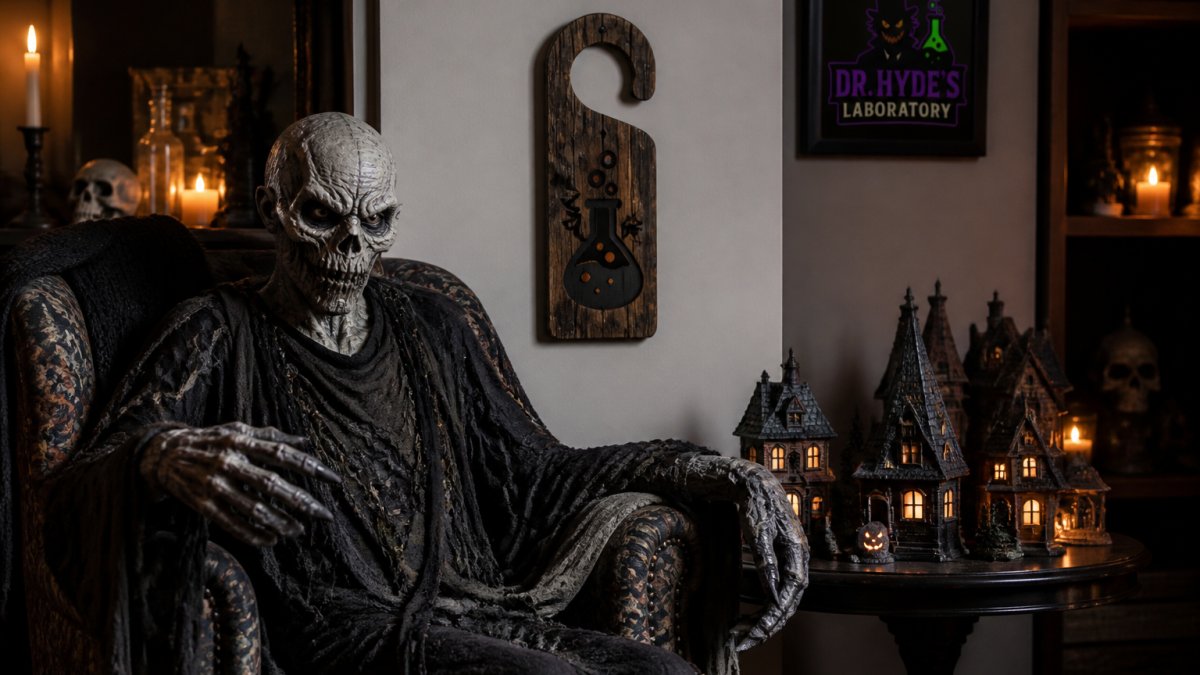
Start with a scare level, then pick the piece
Think in three tiers and choose one tier per room:
- Subtle (everyday eerie): small ornaments, a single door hanger, a miniature village. These read as decor first and horror second, so they can stay up past the season.
- Medium (conversation piece): one posable figure, a sculpted bust, or a themed centerpiece. Guests notice it, but the room still functions as a room.
- Bold (scene-setting): large props, animatronics, and full vignettes. Best reserved for entryways, basements, garages, and dedicated party spaces.
A common pattern is one bold piece per room, supported by two or three subtle ones. Stacking multiple bold pieces in a shared living space is what makes a home feel like a store display.
Match the piece to the room
- Entryway: a wooden door hanger sets the tone before guests step inside. Keep it at eye level, roughly 60-66 inches from the floor, so it reads on the way in.
- Living room: one posable figure in a chair or on a side table adds a creepy guest without clutter. Leave at least a foot of clear space around it so it does not look crammed against other decor.
- Mantel or shelf: a small village set or a single ornament gives a subtle, everyday scare. Group odd numbers (three or five pieces) at varying heights for a collected look rather than a row.
- Bathroom or hallway: small resin ornaments and wall pieces work here because there is no floor space to give up. Avoid latex and fabric in damp rooms.
- Party space: larger props and animatronics carry the room for events. This is the one place where more is genuinely more.
Scale and lighting rules that make it work
Scale is the most common mistake. A prop that looks impressive in a product photo can dwarf a nightstand.
Lighting does more for atmosphere than any single prop. A small uplight or a warm low-wattage bulb placed below a figure throws shadows upward and makes a sculpted face read as unsettling instead of cute. Avoid bright overhead light on bold pieces; it flattens the detail you paid for.
Immersive Horror Room Design: Building a Narrative
Immersive horror room design starts with a story, not a pile of props. Ask what happened in this room before guests arrived.
A single figure posed in a chair tells a story. A group of random props just looks like a store display.
This is where Dr. The Halloween Village Set is a good example: a handcrafted miniature display that builds a whole world on a mantel or table.

How to Style Gothic Decor Without Looking Tacky
How to style gothic decor comes down to restraint. One strong statement piece beats ten cheap ones. Gothic style works when it feels curated, not cluttered.
A few rules we follow:
- Pick a focal point first, then build around it.
- Keep the color palette tight: black, deep red, aged gold, muted greens.
- Mix textures: wood, resin, velvet, and worn metal.
- Leave empty space so the eye can rest.
- Skip the plastic junk that reads as costume-shop filler.
The goal is a character-rich, lived-in space. A handcrafted wooden door hanger next to a single candle does more than a wall covered in printed cutouts. For a buyer checklist, our team at Dr.
Budget, Value, and a Buyer Checklist for Handmade Pieces
Handmade horror decor often costs more upfront than store-bought decorations, but that is not always true, and price alone is a poor signal of quality. What you are really paying for is materials, handwork, and a piece that lasts for years instead of one season. Understanding what drives the price helps you tell a fair deal from an overpriced one.
What actually drives the price
- Material: resin, latex, and hardwood cost more than thin plastic and printed cardboard, and they behave differently over time.
- Handwork hours: hand-sculpting, hand-painting, and finishing take time. A piece with fine painted detail carries more labor than a single-color cast.
- Batch size: one-of-a-kind and small-batch pieces cost more per unit than items a maker can repeat.
- Hardware and finish: posable armatures, UV coatings, and quality hanging hardware add cost but also add usable life.
- Customization: personalization, custom sizing, and made-to-order work add both cost and lead time.
A useful way to judge value is cost per season. That math, not the sticker price, is the real comparison.
A buyer checklist for evaluating handmade listings
Run this before you buy any handmade piece:
- Is the material listed clearly (latex, resin, wood, fabric, or mixed)?
- Are exact dimensions and weight stated, not just "large" or "life-size"?
- Is the finish described as hand-painted, hand-sculpted, or both?
- Are indoor or outdoor use and any UV or weather treatment noted?
- Is there a stated care routine (dusting, storage, temperature limits)?
- Can it be stored flat or in a box, and does it ship with protection?
- What is the return window, and who pays return shipping?
- For made-to-order pieces, what is the stated production and shipping lead time?
- Does the seller answer questions about materials and process directly?
- Does it fit the room and scare level you already chose?
Verifying maker claims and ethical sourcing
"Handmade" is used loosely, so it helps to look for specifics. A maker who describes their process, shows work-in-progress photos, and names their materials is easier to trust than a listing that only uses the word handmade. If sourcing matters to you, ask where the base materials come from and whether pieces are made in small batches.
Care and storage so the value holds
Care is part of the cost of ownership. Store latex and resin pieces away from direct sun, and dust them with a soft cloth instead of harsh cleaners. Keep latex out of hot attics and cold garages, since temperature swings dry out the material and crack the paint. Pack pieces with padding rather than stacking them, and label boxes by room so next season's setup is fast.
Conclusion: Choose Pieces That Tell a Story
The real test of any decoration is whether it makes a room feel different. Mass-produced pieces fill space. Handmade horror decor builds a scene, tells a story, and stays with you long after the season ends.
If you want pieces with that kind of depth, browse our collection at Dr. Hyde's Laboratory. We offer unique, non-conventional styles, fast shipping, and a focus on design that blurs the line between narrative and environment.
Frequently Asked Questions
What makes handmade horror decor different from mass-produced decorations?
Handmade horror decor is individually crafted, so each piece has small variations in paint, sculpt, and finish that mass-produced items lack. Artisans often use durable materials like latex, resin, or UV-coated wood, and they build in details such as posable armatures or hand-painted shading. That labor and material quality means the piece holds up over multiple seasons and reads as a one-of-a-kind statement rather than a repeated store-bought shape.
How do I choose handmade horror decor that fits my room and scare level?
Start by matching the piece to the space. A subtle gothic door hanger works for an entryway, while a 36-inch posable monster figure suits a focal corner or party room. Then set your scare level: low-key pieces for everyday living areas, high-impact props for haunted house zones. Check dimensions, mounting needs, and whether the item is indoor or outdoor rated before buying so it fits both the room and the mood you want.
Is handmade horror decor worth the higher price compared to big-box Halloween decorations?
The price reflects materials, hand labor, and limited production runs. A $65 handcrafted door hanger or a $147.99 posable figure is built to be reused and displayed year after year, while cheaper mass-produced pieces often crack, fade, or get tossed after one season. If you want a piece that doubles as a collectible and anchors a display, the cost per year of use is often lower than replacing disposable decor.
How can I style handmade horror decor year-round without it looking like leftover Halloween?
Treat handmade horror pieces as part of your regular interior design. Place a hand-painted ornament or a small village set on a shelf with books and candles, or let a posable figure sit in a reading chair as a year-round oddity. Mix in gothic textures like dark wood, velvet, and aged metal, and keep the surrounding decor neutral so the piece reads as intentional art rather than seasonal clutter.