

Is Renting Haunted House Props Worth It? Compare Your Options
Quick Summary
Renting haunted house props suits one-time events or short runs, but buying used or building DIY props usually costs less for repeat events. Compare the full cost over two or three seasons, including delivery, damage waivers, and storage, before choosing.
- Renting fits one-time events or short runs with a specific large display.
- Add delivery fees, damage waivers, and storage costs before comparing rental prices.
- Rental contracts should specify the rental period, pickup windows, and failure terms.
- Buying a prop outright can pay off after roughly two seasons of use.
- Photograph every prop at pickup and return to document its condition.
Table of Contents
- Comparing Renting, Buying Used, Borrowing and DIY
- DIY Haunted House Props You Can Build This Weekend
- Halloween Decoration Rentals: What to Check in the Contract
- Rent Halloween Animatronics or Buy Them Outright
- Budget Haunted House Ideas by Event Scale
- Choosing Your Next Prop Based on Reuse and Storage
- Frequently Asked Questions
Why Look Beyond Renting Haunted House Props
Renting haunted house props is the default for many Halloween event planners, but it is not always the best fit. Props built to tell a story rather than just startle can make a haunted house feel more immersive. Alternatives to renting can give you that immersion at a lower long-term cost.
The main alternatives are buying props outright, buying used, borrowing from friends or community groups, and building your own. Each has trade-offs in cost, effort, storage, and creative control. The right choice depends on your event scale, your budget, and how often you plan to run the event.
Haunted house props are the centerpiece of most Halloween attractions, so the choice matters. A rented prop may look fine on day one, but it rarely matches the narrative you want your guests to walk through. Owning even a few signature pieces lets you build a consistent theme year after year.
Our goal here is to help you compare your options honestly. We will cover the cost of each path, walk through practical DIY builds, explain what to check before signing a rental contract, and show how to choose props based on reuse and storage.
Halloween decoration rentals are popular because they require no storage and no upfront purchase. Pricing and quality can vary widely from one provider to the next. Read terms carefully and ask for condition reports before you commit.
Comparing Renting, Buying Used, Borrowing and DIY
Each option has a clear best-fit scenario. Renting works well for one-time events or when you need a specific, large display for a short window. Buying new gives you full control and a prop you can reuse every season. Buying used can cut costs substantially, though you should inspect the condition and confirm the electronics still work. Borrowing and DIY cost the least in cash but demand the most time.
| Option | Upfront Cost | Ongoing Cost | Effort | Best For |
|---|---|---|---|---|
| Renting | Low | Per event | Low | One-time or short runs |
| Buying new | High | Storage only | Low | Repeat annual events |
| Buying used | Medium | Storage and repairs | Medium | Budget-conscious repeat use |
| Borrowing | Free | Transport | Medium | Community or school events |
| DIY | Low to medium | Materials and storage | High | Creative control on a budget |
A common mistake is comparing only the sticker price. Factor in delivery and pickup fees, damage deposits, and the cost of storing props between seasons. A rental that looks cheap can cost more than a used purchase after two or three events.
DIY Haunted House Props You Can Build This Weekend
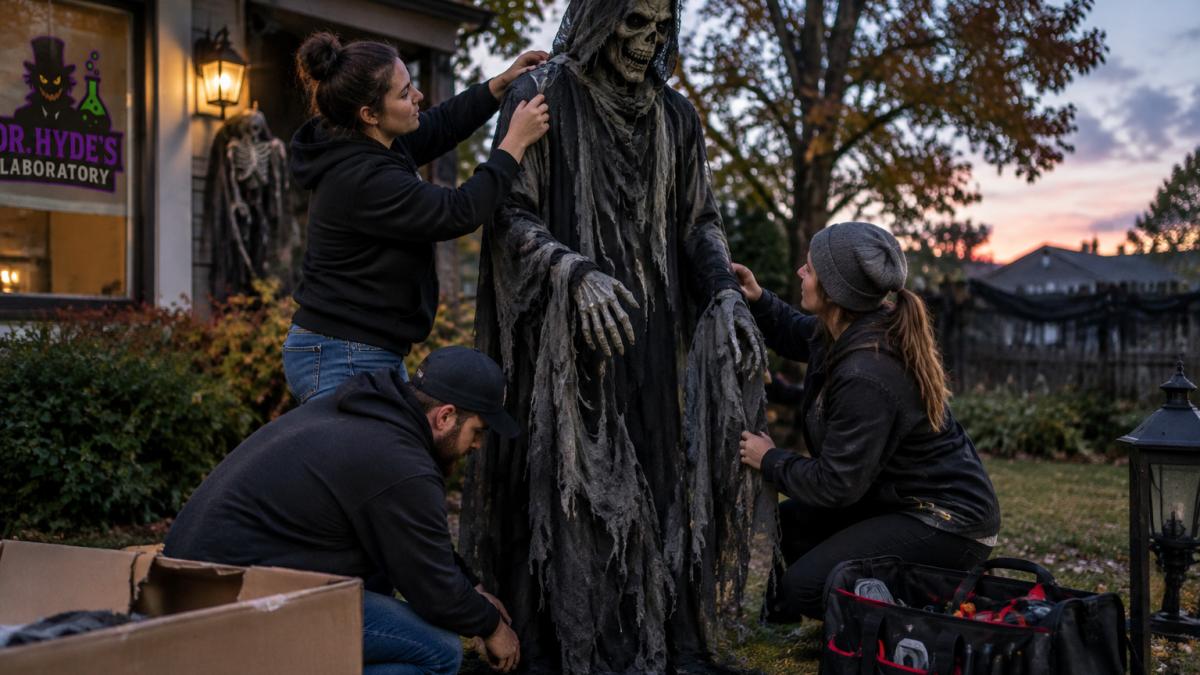
Many effective props can be built from inexpensive materials. A scarecrow or figure is a good starting point. Stuff old clothing with crumpled newspaper or junk mail, add a mask or pillowcase for the head, and secure the form to a wooden frame. This approach is a common low-cost option, though the results are rough and best suited to yard displays where guests view props from a distance.
Tombstones are another easy build. Cut foam board or plywood into tombstone shapes, paint them with gray and black tones, and add weathering with a dry brush.
Flickering candles and hanging cages add atmosphere at low cost. Battery-operated LED candles and thrift-store birdcages can transform a hallway or entryway.
DIY builds work best when you plan the layout first. Sketch where each prop will sit, check sightlines, and make sure guests have a clear path through the space. Keep sharp edges and loose wiring away from walkways, and test every build before opening night.
Halloween Decoration Rentals: What to Check in the Contract
Rental contracts for haunted house props vary widely, and the terms you sign can cost more than the quoted rental fee.
Rental period and pickup windows. Confirm the clock starts on the day the prop leaves the warehouse, not the day of your event.
Delivery, setup, and pickup fees. Many providers quote the prop separately from transport. Ask for a written delivery quote that includes liftgate or stairs charges, inside placement, and pickup.
Deposits and damage waivers. A refundable security deposit is common, but the damage waiver is the line that surprises planners.
Failure and replacement terms. Find out what happens if an animatronic motor dies mid-event. A common pattern is a replacement or credit only if the failure is reported within a set window, often 24 hours.
Cancellation and weather policy. Refund schedules usually step down as the event date approaches, for example, full refund 30 days out, partial refund 14 days out, no refund inside 7 days. Ask whether a weather cancellation at an outdoor event qualifies for a credit, and get the policy in writing rather than relying on a phone conversation.
Insurance and liability. Ask whether the provider requires you to carry general liability coverage or to name them as an additional insured.
Safety and sanitation checks before signing. Ask for the prop's electrical rating and whether it is UL-listed for indoor or outdoor use.
Accessibility and setup footprint. Ask for the assembled dimensions and weight of each prop, not just the shipping box size.
47" Animated Rising Skeleton In Coffin →
Watch out: a low weekly rate can hide a non-refundable damage waiver, a mandatory delivery fee, and a short return window that together exceed the cost of buying a used prop outright.
Rent Halloween Animatronics or Buy Them Outright
Animatronics are the most expensive props in most haunted house budgets. Renting one is often the right call for a single season, but buying can pay off if you run the same attraction every year. Animated props from our catalog show what outright purchase looks like in practice. The 47" Animated Rising Skeleton In Coffin ($180.99) is sound-activated and rises from its coffin to startle guests in a haunted house scene. See a similar oversized outdoor prop to compare purchase value against renting. It is made of polyester and plastic and measures 47" x 17 1/4" x 8". The 6FT Animated Standing Zombie ($199.99) runs on 4 AA batteries, which are included, and suits a haunted house display, party photo booth, or front porch setup. Browse another large lantern-style statement piece to gauge reusable value.


Compare the purchase price against your rental quotes over the number of seasons you plan to run the event. If the math favors buying, check battery requirements and storage space before you commit.
Budget Haunted House Ideas by Event Scale
A more useful approach is to build an itemized budget that captures costs such as transport, storage, labor, power, and replacement parts, transport, storage, labor, power, and replacement parts, and then match the plan to your event scale.
Build a total-cost-of-ownership sheet. For each option, list these line items and total them over the number of seasons you plan to run:
- Purchase or rental fee
- Delivery, pickup, and transport (fuel, trailer rental, or a friend's truck)
- Storage (shelf space, climate control, or a rented storage unit)
- Labor (setup and teardown hours at your own rate or paid crew)
- Power (battery replacements, extension cords, generator fuel)
- Consumables (fog fluid, makeup, replacement bulbs, tape, paint)
- Repairs and replacement parts
- Insurance or damage waiver
A prop that rents for a low weekly fee can still lose to a used purchase once delivery, the damage waiver, and a second season of rental are added. Run the math over two or three seasons before deciding.
Small home or yard display (a few dozen guests). Keep the budget weighted toward DIY and one focal purchased piece.
School, church, or community event (one night, volunteer labor). Borrowing and DIY dominate here because cash is tight and labor is free. Budget for transport and a small repair reserve rather than for rental fees.
Mid-size ticketed attraction (a few weekends). A mixed model works best: buy two or three reusable animatronics and rent specialty set pieces for the run. Budget a line for a licensed electrician if you are adding circuits, and a line for a generator if the venue lacks adequate power. Price the rental's damage waiver into the plan rather than treating it as a surprise.
Large recurring attraction (multi-week, multi-season). Ownership wins on cost per guest once you pass roughly two seasons, but only if you budget storage and maintenance honestly. Allocate a maintenance reserve of a few percent of the prop's purchase price per year for motors, wiring, and fabric repair. Plan storage with climate control for electronics and pest control for fabric and foam.
Where to source secondhand and borrowed props. Resale channels, community theater groups, school drama departments, and local buy-nothing or freecycle groups can be sources for used props and set pieces.
Watch out: a budget that omits transport, storage, and a repair reserve will look balanced on paper but overrun in practice, usually in the final week before opening night.
Choosing Your Next Prop Based on Reuse and Storage
Before buying, decide how often you will use the prop. A piece you will display every year justifies a higher upfront cost. A one-time theme does not. Consider storage too. Large animated figures like the 6FT Animated Standing Zombie need room to store safely between seasons, so measure your space first.
The 3 Ft Upside Down Animated Girl ($45.99) and the 5FT Standing Animated Clown ($114.99) offer different price points for hanging and standing displays. Compare a standalone troll figure you can store between seasons. Pick based on where the prop will sit and how much room you have. Look at a sturdy monster figure with stringy hair as a second option for comparing reuse value.

Check battery compartments, keep prop covers dry, and store electronics in a cool, dry place. Good storage extends the life of every prop you own.
Explore the Dr. Hyde's Laboratory collection to find props that suit your event and budget.
Frequently Asked Questions
What are the best alternatives to renting haunted house props?
The main alternatives are buying purpose-made props, buying used pieces, borrowing from friends or community groups, and building your own. Buying a single animated piece from Dr. Hyde's Laboratory, such as the 6FT Animated Standing Zombie at $199.99, gives you a prop you can reuse every season. Borrowing costs nothing but depends on availability, and DIY lowers cash cost while adding build time. The right choice depends on how many events you run and how long you need the props for.
Is it cheaper to rent or buy Halloween props?
It depends on how often you use them. Renting spreads cost across one event, which suits a single season or a one-time party. Buying makes sense when you will reuse a prop across several years or events. For example, the 2 Ft Animated Crouching Monster sells for $137.99 and the 3 Ft Upside Down Animated Girl for $45.99, so two or three seasons of use can make a purchase cheaper than repeated rentals. Factor in shipping, batteries and storage when you compare totals.
Where can I find affordable props for a haunted house?
Start with secondhand sales, community swap groups and local haunt volunteers who may lend pieces. For new props, compare starting prices across sellers and look at smaller items first, such as the 3 Ft Upside Down Animated Girl at $45.99, before committing to large figures. Building simple props from foam, fabric and lighting can cover gaps at very low cost. Keep a running list of what you already own so you do not buy duplicates.
How can I make haunted house props at home?
Simple props can be made with cardboard, foam board, fabric, paint and battery-powered LED lights. Stuff old clothing with newspaper or crumpled junk mail to create figures, then add a mask or pillowcase head. Cover tombstones with painted foam and add flickering candles for atmosphere. Test every prop for stability and fire safety before guests arrive, and keep electrical components away from moisture and high-traffic paths.
Ready to build a haunted house that owns its atmosphere? Dr. Hyde's Laboratory offers animated props, horror props, and immersive decorations designed to heighten immersion. Continue shopping to find the right pieces for your next event.
