

How to Verify Horror Costume Sizing Before You Buy
Last Updated: November 7, 2026
Quick Summary
To verify horror costume sizing, take five measurements (chest or bust, natural waist, hips, height, and inseam) and match them to the size chart on that specific product page, not a general sizing page. Choose the size that fits your largest measurement, and check customer photos and reviews for real fit details.
- Measure chest or bust, natural waist, hips, total height, and inseam with a soft tape measure.
- Read the size chart on the specific product page, since sizing varies by manufacturer and style.
- When between sizes, choose the larger size for woven, structured, or layered horror pieces.
- Skip reviews without height or usual size, and trust customer photos over studio shots.
- Measure over any base layers you plan to wear under the costume.
Table of Contents
- Why Horror Costume Sizing Fails Before You Even Order
- How to Measure for a Costume: The Five Numbers That Decide Fit
- Reading an Adult Costume Size Chart Without Guessing
- Costume Sizing Between Sizes: Which Way to Go
- What Costume Sizing Reviews and Customer Photos Actually Tell You
- Horror Costume Fit: Layers, Proportions, and Movement
- Your Pre-Order Sizing Checklist for Dr. Hyde's Laboratory Pieces
- Frequently Asked Questions
Why Horror Costume Sizing Fails Before You Even Order
Horror costume sizing fails most often because shoppers trust a clothing-size label instead of the specific costume's measurements.
Someone orders a "one size fits most" piece, it arrives, and it hangs wrong or pulls tight across the shoulders. The costume itself may be fine; the size choice is often the problem.
The fix starts before checkout. Below, we'll show you how to verify horror costume sizing step by step, using five body measurements and a size chart you read the right way.
Here's what most guides get wrong: they tell you to "size up" as a blanket rule. That advice fails for layered horror pieces, where extra fabric can swallow the silhouette you paid for.
If you want a deeper look at what separates a costume that lasts from one that falls apart, our guide to 8 quality checks for choosing horror costumes that last covers the construction side.
How to Measure for a Costume: The Five Numbers That Decide Fit
To measure for a costume, take five numbers with a soft tape measure: chest or bust, natural waist, hips, total height, and inseam. Write each one down in inches. These five numbers are what every adult costume size chart is built around.
A few habits make the numbers reliable:
- Wear fitted clothing. Bulky layers add inches that aren't you.
- Keep the tape level. A tape that dips at the back reads wrong.
- Stand relaxed. Don't suck in or puff out your chest.
- Measure twice. If the two readings differ, take a third.
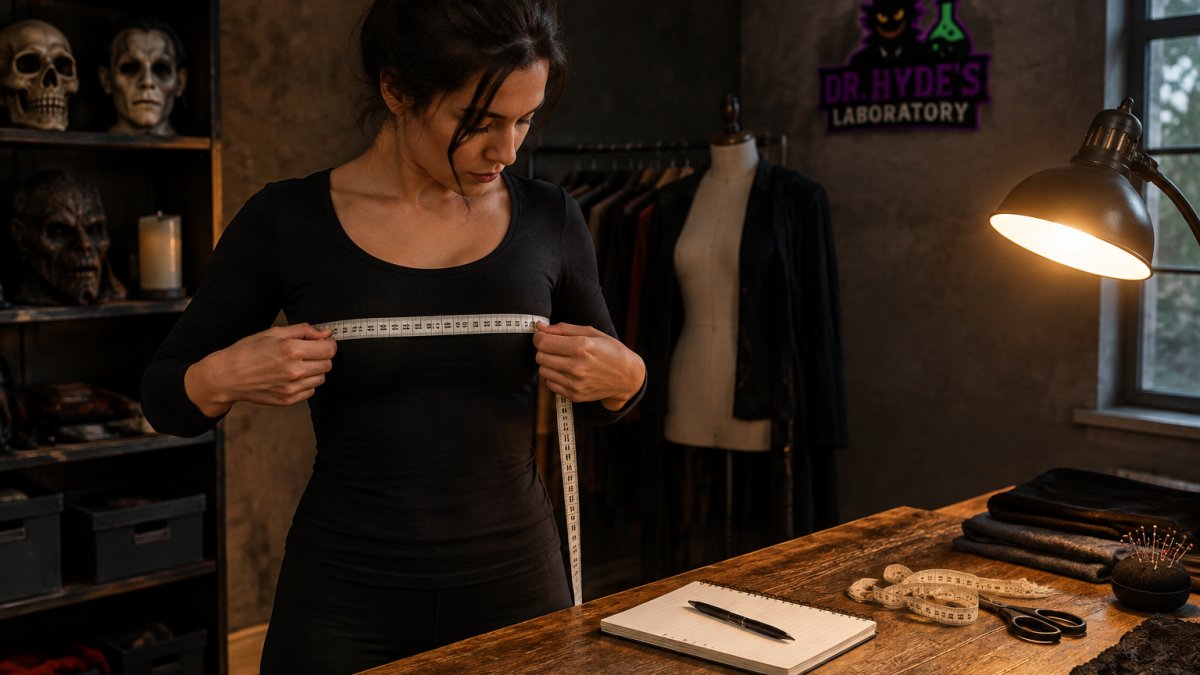
Chest or Bust, Waist, and Hips
For chest, wrap the tape around the fullest part of the chest, under the arms, and keep it level across the back. For bust, measure the same way but at the fullest point of the bust.
For natural waist, find the narrowest point of your torso, usually just above the belly button. Don't measure where your jeans sit.
For hips, measure around the fullest part of the hips and rear, usually about 8 inches below the natural waist.
Height and Inseam
Total height is measured standing straight, barefoot, from the floor to the top of your head. This matters for full-body horror pieces and anything with a long hem.
Inseam runs from the crotch seam to the floor along the inside of the leg. You can measure a pair of pants that fit you well instead of measuring your own leg.
Reading an Adult Costume Size Chart Without Guessing
An adult costume size chart lists body measurements, not your clothing size, and you match your numbers to the chart rather than picking the size you wear at a department store. Check the chart on the product page for that specific costume, because sizing varies by manufacturer and even by style within one brand.
Here's how to read one:
- Find the chart on the product page, not a general sizing page.
- Compare each of your five measurements to the chart's columns.
- Note the size that fits your largest measurement, not your smallest.
- Check the size dropdown for that exact size.
- If the chart lists garment measurements too, compare those against your body.
That last point matters for horror pieces. A costume with a 34-inch chest measurement won't fit a 38-inch chest, no matter what the tag says.
If you're shopping a fitted, structured piece, applying the chart to a real example helps. Our women's plus size bride costume shows how a specific garment's chart maps to actual body numbers.

Costume Sizing Between Sizes: Which Way to Go
When your measurements fall between two chart sizes, the decision should be driven by three factors in this order: the garment's construction, the largest relevant body measurement, and how much movement the costume needs to allow. Most shoppers reverse that order and start with the size they wear in street clothes, which is why between-sizes orders fail so often.
Start with construction. Woven, structured, and layered horror costumes have little give. A tailored jacket, a corseted bodice, a foam-latex chest piece, or a heavy robe with set-in sleeves will not stretch to meet you.
Next, let your largest relevant measurement decide. If your chest reads as a medium but your hips read as a large, order the large.
Then weigh movement. Horror costumes often restrict the wearer by design, high collars, full masks, capes, trailing hems, and bulky prosthetics all reduce your range.
Use this decision framework:
| Your situation | Choose | Reason |
|---|---|---|
| Between sizes, woven or structured bodice | Larger | Seams and boning do not stretch |
| Between sizes, stretch bodysuit or knit base layer | Smaller | Fabric recovers; loose stretch sags |
| Between sizes, layered or padded horror piece | Larger | Layers need clearance at shoulders and waist |
| Between sizes, full mask or high collar | Larger | Neck and head clearance cannot be tailored in |
| Between sizes, long robe or cape | Larger | Hem can be shortened; length cannot be added |
| Between sizes, plus-size cut | Larger | Plus-size grading varies by maker and often runs small |
| Chest reads one size, hips read another | Match the larger | Letting out is harder than taking in |
| Height reads one size, girth reads another | Match height for full-body pieces | Hem and torso length are fixed |
Watch out: a size chart that lists only body measurements and no garment measurements hides the fact that a costume may be cut close to the body even in a larger size.
A common mistake is ordering down because the model in the photo looks slim in it. Our plus size Forgotten Souls costume is a good piece to study here, since it shows how a specific horror design handles the between-sizes call in practice.

What Costume Sizing Reviews and Customer Photos Actually Tell You
Build a short list of fit phrases and search the review section for each one.
- "I'm usually a medium and ordered a large"
- "tight across the shoulders"
- "runs small" or "runs large"
- "plenty of room in the hips"
- "true to the chart"
- "couldn't raise my arms"
- "hem dragged on the floor"
- "mask wouldn't fit over my head"
A review that says "fits perfectly" without a height or usual size tells you nothing. Skip it.
When reviews conflict, weight them by specificity and recency. A detailed review from someone whose height and usual size match yours outranks a one-line review from an unknown body.
Customer photos beat text for judging horror-specific fit. Look at four things:
- Where the fabric pulls. Pull lines radiating from the armpit or across the chest mean the garment is too small there, regardless of what the reviewer wrote.
- How the hem sits. A floor-length robe that pools around the model's feet in a customer photo will do the same on you if your height matches.
- Whether the mask or headpiece sits naturally. A mask that tilts back or rides up in photos is a sign the opening is too small or the fit is unstable.
- How capes and layered pieces drape. A cape that bunches at the shoulders in a real photo will bunch on you too.
Watch out: studio photos are lit and pinned to flatter the garment, and some listings reuse the same model shot across multiple sizes. Trust customer photos over studio shots every time.
If you find no reviews with height and size details, treat the size chart as your only source and apply the between-sizes framework above. Our horror robe costume is a good example of a piece where customer photos reveal drape and hem length that the chart alone cannot.
Horror Costume Fit: Layers, Proportions, and Movement
Horror costume fit depends on movement as much as measurement. A piece can match your chest and waist numbers and still fail the moment you raise your arms, crouch, or walk up stairs. Test fit against what you'll actually do in the costume.
Run through these before you commit:
- Raise both arms overhead. Does the shoulder seam pull or the hem lift?
- Squat and bend forward. Does the waistband dig in?
- Walk a flight of stairs. Does the hem catch underfoot?
- Turn your head fully. Does the collar or mask restrict you?
- Sit down. Does the back of the costume ride up?
Layered pieces need extra room at the shoulders and waist. If you're wearing a robe over a base layer, measure while wearing the base layer.
Proportions matter too. A long robe on a shorter frame will pool at the floor. A cropped piece on a taller frame will sit higher than intended. Height and inseam are the numbers that catch this.
Your Pre-Order Sizing Checklist for Dr. Hyde's Laboratory Pieces
Before you order any horror costume, run this checklist. It takes five minutes and prevents the return.
- Measured chest or bust, waist, hips, height, and inseam
- Found the size chart on that specific product page
- Compared all five measurements to the chart
- Checked the size dropdown for the exact size
- Read reviews for height, usual size, and fit notes
- Viewed customer photos for pull points and hem length
- Tested movement if trying on in person
- Measured over any base layers you plan to wear
- Confirmed the return or exchange window
Apply that list to a specific piece before you commit. Our gothic bride adult costume is a good one to practice on, since the structured bodice and long skirt both depend on accurate waist and height numbers.

At Dr. Hyde's Laboratory, we build pieces that blur the line between design and narrative, and a costume only tells its story when it fits the person wearing it.
Sizing a horror costume is a five-minute job that saves a ruined night.
Frequently Asked Questions
How do I know what size Halloween costume to get?
Measure your chest or bust, natural waist, hips, height, and inseam with a soft tape measure, then compare those numbers to the size chart on the specific product page. Ignore the size you wear in street clothes, since horror costume sizing varies by manufacturer and a medium from one maker can match a large from another. If your numbers land between two sizes, check the fabric and cut before deciding which way to go.
Should I size up when ordering a costume online?
Size up when the costume is form-fitting, non-stretch, or designed to be worn over layers, armor, or a padded under-suit. Size down only when the chart shows your measurements comfortably inside one size and the fabric has stretch. Comfort and fit matter to costume buyers, so it pays to check the chart rather than assume your usual label works.
What should I do if my measurements fall between costume sizes?
Match the size to your largest critical measurement first, usually chest or hips, then check whether the waist can be adjusted with a belt, lacing, or ties. For horror costume sizing between sizes, read the product description for stretch and closure type. If the piece is rigid or heavily structured, go with the larger size and plan on tailoring; if it is stretch mesh or spandex, the smaller size often fits closer to the intended silhouette.
How can I verify costume sizing before buying online?
Open the product page, find the size chart, and write down your five measurements next to the chart's numbers. Then read costume sizing reviews for height and weight mentions and look at customer photos to judge drape and length on real bodies. Finally, confirm the return or exchange window before you order. If a listing has no chart and no customer photos, treat that as a warning sign rather than a reason to guess.
