

How to Create Immersive Haunted House Atmosphere
Table of Contents
- Start With a Story: Haunted House Themes and Storylines
- Haunted House Lighting Ideas That Build Dread
- Haunted House Sound Effects and the Power of Silence
- Fog, Haze, and Props That Make the Space Feel Real
- A Room-by-Room Plan for Immersive Haunted House Atmosphere
- Budget Tiers: Building Haunted House Atmosphere on Any Budget
- Haunted House Safety Tips, Accessibility, and Visitor Flow
- Test, Adjust, and Pace the Scares
- Frequently Asked Questions
Last Updated: October 16, 2026
Start With a Story: Haunted House Themes and Storylines
A haunted house without a story is just a dark room with props. Hyde's Laboratory breaks down how to create immersive haunted house atmosphere room by room, on any budget.
Haunted house atmosphere is the combined effect of lighting, sound, props, scent, and pacing working toward one goal: making guests feel like they have stepped into another world.
Pick one storyline and commit to it. Common frameworks include:
- The abandoned asylum - decay, restraint props, flickering fluorescent light
- The Victorian funeral parlor - candlelight, mourning drapes, slow organ music
- The steampunk laboratory - brass fittings, bubbling vials, electrical hum
Write your story in three sentences: where guests are, what happened here, and what is still lurking.
Haunted House Lighting Ideas That Build Dread
Lighting is the single most powerful atmosphere tool you control. You are not lighting a room for visibility. You are lighting it to hide things.
The best haunted house lighting ideas share one trait: they never let guests see the full space at once. Darkness does the heavy lifting. Light just tells guests where to look next.
Three rules cover most setups:
- Light the path, not the room. A dim guide light at floor level moves guests forward.
- Keep the source hidden. If guests see the bulb, the effect breaks.
- Use color with intent. Purple and green read as unnatural; amber reads as old and decaying.
Placement, Layering, and Timing That Actually Work
The difference between a flat room and a dread-soaked one is where fixtures sit, how many layers you run, and when each one fires.
Placement heights. Home haunt builders commonly work in three vertical bands:
- Floor level (0-12 inches): uplights tucked behind props or under fog. These throw long shadows up walls and make fog glow.
- Mid level (3-5 feet): the working band for path guidance. Keep these dim and aimed down so guests see footing without seeing the room.
- Overhead (7 feet and up): the least-used band. A single dim overhead source creates a pool of light guests must walk through, which feels exposed and uneasy.
Layering. Run at least two lighting layers per room: a steady low ambient wash plus one unreliable accent, a flicker, a slow pulse, or a shifting color.
Timing. Flicker and pulse effects land harder when they are not constant.
Flickering Lights, Shadows, and Unreliable Sources
Flicker creates unease because the brain cannot predict what comes next. A steady light feels safe. An unreliable one does not.
You do not need expensive gear. A purple string light set, like our Light Set 50 Purple W Conn, runs $13.99 and casts an eerie glow along a doorway or porch. Combine it with orange for contrast, or run it alone for a colder, witchier feel.

What most guides miss is shadow placement. Put a light source low and behind a prop, and the shadow it throws becomes the scare. Two practical rules:
- Distance controls drama. The closer the light is to the prop, the larger and softer the shadow. Pull the light back and the shadow sharpens and stretches.
- Angle controls direction. A light aimed slightly upward makes shadows climb the wall, which reads as something rising. A light aimed down flattens the room and kills the effect.
Testing Sightlines Before Opening Night
Lighting that looks right in a lit room often fails in the dark. Walk the path with every other light off and check three things:
- Can guests see the next scare before they reach it? If yes, move the source or add a blocking prop.
- Is the floor visible enough to walk safely? If not, add a floor-level guide light, safety and atmosphere are not in conflict here.
- Does any fixture cast light on a wall you wanted dark? A single stray beam can flatten an entire room's mood.
A cheap test without rewiring: walk the route at night with a flashlight held at the height and angle of each planned fixture. Whatever the beam touches is what guests will see.
Haunted House Sound Effects and the Power of Silence
Sound tells guests what they cannot see. A low rumble under the floor suggests something moving beneath them; a sudden silence suggests it has stopped.
The mistake most builders make is running sound at full volume from open to close. Constant noise becomes background; contrast makes sound work.
Creaking Doors, Ghostly Whispers, and Ambient Sound
Build your soundscape in three layers:
- Base layer: a continuous ambient bed, such as wind, dripping water, or a low drone
- Mid layer: intermittent sounds, including creaking doors, footsteps, and rattling chains
- Top layer: sharp, sudden effects like a scream or a slam, used sparingly
Ghostly whispers work best when guests cannot tell where they come from. Place small speakers behind walls or inside props, not next to the guest's ear. Directional confusion is more unsettling than volume.
Fog, Haze, and Props That Make the Space Feel Real
Fog does two jobs at once. It hides the floor, so guests cannot see where they are stepping, and it catches light, so beams and shadows become visible in the air.
A mist maker is the cheapest way to add real fog. Our Mist Maker With LED costs $32.99. Drop it in a shallow container of water, plug it into a 110 outlet, and it produces color-changing, non-toxic fog.

Choosing the Right Fog for the Room
Not all fog behaves the same, and picking the wrong type is the most common reason a room feels foggy instead of haunted.
- Low-lying fog (mist makers, dry ice, chilled fog): hugs the floor, hides footing, and makes light beams visible at ankle height. Best for corridors and entryways where you want guests to feel like they are wading through something.
- Haze (fine, even, slow-drifting): fills the air without pooling. Best for larger rooms where you want beams and shadows to read across the whole space. Haze is what makes a spotlight look like a spotlight.
- Burst fog (fog machines): dense and short-lived. Best for a single scare moment, a figure appearing out of nothing, not for continuous atmosphere.
A practical rule: use low-lying fog where guests walk, haze where guests look, and burst fog only at the peak scare.
Ventilation, Safety, and Placement
Fog and haze are only atmospheric if guests can still breathe and see the exit. Non-negotiables:
- Ventilate. Even water-based fog and haze concentrate in enclosed spaces. Run a fan on low to keep air moving, and never seal a room with a running fogger.
- Keep fog off the floor path itself. Fog that hides footing is atmospheric; fog that hides a step or a cable is a hazard. Place mist makers beside the path, not on it.
- Watch the water. Mist makers need a shallow container and a stable surface. A tipped container near a walkway is a slip risk and an electrical one.
Props That Earn Their Place
Props should look like they belong in the story, not like they were bought yesterday. Stretch spider webbing sells the "abandoned for years" look for almost nothing: our Spider Web 40GR White is $4.99 and covers 135 square feet, enough to age a whole hallway.

For a bigger centerpiece, a hanging figure does more work than a shelf of small items. The 6FT Hanging Reaper With Lights And Sound at $50.99 has red glowing eye sockets and orange and black robes, and it pairs well with gravestones for a quick graveyard scene.
What separates a prop that works from one that just sits there is how it interacts with fog and light:
- Backlit props read as silhouettes. Put a light behind a hanging figure and guests see a shape, not a costume. Silhouettes are scarier than detail.
- Fogged props read as distant. A prop half-hidden in haze feels farther away than it is, which buys you space in a small room.
- Animated props need a trigger. A prop that moves constantly becomes furniture. Tie it to a motion sensor, a foot switch, or an actor so it fires only when a guest is in position.
Aging Props Without Buying New Ones
The cheapest way to make a room feel real is to make everything look older than it is. A few household techniques:
- Dust with flour or cornstarch on horizontal surfaces, shelves, sills, tabletops, to suggest years of neglect.
- Tea-stain fabric and paper to yellow and wrinkle them. Cheap, reversible, and it reads as age rather than dirt.
- Break the symmetry. Straight rows of props look staged. Cluster some items, tip others, and leave one thing out of place.
A Room-by-Room Plan for Immersive Haunted House Atmosphere
Build the route before you buy anything. Walk the path guests will take, mark each turn, doorway, and dead end, then assign one mood per zone.
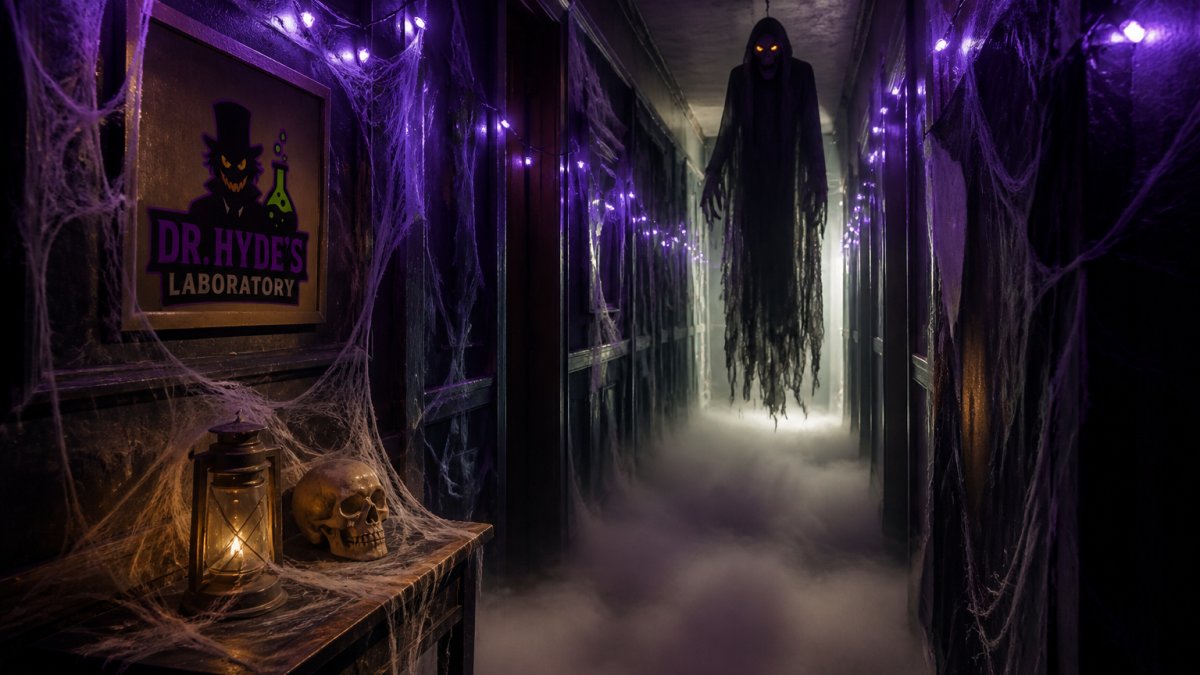
A simple four-zone structure works for most home haunts:
| Zone | Goal | Main Tools |
|---|---|---|
| Entry | Set the story | Signage, low light, ambient sound |
| Build-up | Raise tension | Fog, whispers, narrow path |
| Peak scare | Deliver the payoff | Sudden light, loud effect, actor or animatronic |
| Exit | Release tension | Brighter light, calmer sound |
Keep the build-up longer than the peak. A scare that arrives too early leaves guests with nothing to anticipate.
Budget Tiers: Building Haunted House Atmosphere on Any Budget
You can build real haunted house atmosphere at three spending levels. Atmosphere comes from layering, not price tags.
Mid budget ($75 to $250): Add a mist maker, a second lighting color, and one large prop like a hanging figure.
Higher budget ($250 and up): Add animatronics, multiple fog sources, and separate sound zones so each room has its own audio.
Haunted House Safety Tips, Accessibility, and Visitor Flow
A scare that causes a fall ends the night early. Safety planning is part of atmosphere design, not an afterthought.
Start with the path. Keep walkways at least 36 inches wide, tape down every cable, and check that all electrical items carry a UL listing and run on the voltage they are rated for.
Then plan for guests who move slower or cannot see well:
- Offer a no-scare option or bypass route
- Keep strobe effects in one area, with a warning sign at the entrance
- Light the floor along the entire path, even in dark rooms
Set a maximum occupancy per room and stagger entry groups. A crowded room kills suspense because guests hear the scare before they see it.
Test, Adjust, and Pace the Scares
Run the haunt start to finish before opening night, with lights and sound exactly as guests will experience them, then walk it again as a guest would, in the dark.
Watch for these problems:
- Dead spots where nothing happens for too long
- Scares that fire too close together, which numbs the reaction
- Props that are visible before their moment
Space your biggest scares at least 90 seconds apart. Give guests a quiet stretch in between so tension can rebuild.
Frequently Asked Questions
What makes a haunted house feel immersive?
Immersion comes from layering multiple senses at once. A single fog machine or a creepy prop alone won't do it. When fog drifts across the floor, purple lights flicker overhead, and a low ambient soundscape plays underneath, visitors stop noticing the room and start feeling like they're inside the story. The goal is to remove reminders of the real world: bright exit signs, plain walls, fluorescent lighting. Every layer you add pulls visitors deeper into the haunted house atmosphere.
How can lighting make a haunted house scarier?
Light controls what visitors can and cannot see, and that uncertainty creates fear. Purple and orange string lights at low angles cast long, distorted shadows. Flickering bulbs make the environment feel unstable. Complete darkness between lit moments forces visitors to imagine threats. A $13.99 purple light set combined with a $32.99 mist maker and LED can transform a plain hallway into something disorienting. The trick is contrast: bright spots followed by deep shadow, never even, flat lighting.
What sounds should you use in a haunted house?
Build three layers: a constant ambient bed (low drones, wind, distant moans), mid-level effects (creaking doors, dripping water, ghostly whispers), and sudden accents (a slam, a shriek) timed to scares. Silence is a tool too. Cutting all sound right before a scare makes the next noise hit harder. Keep ambient volume low enough that visitors must strain to hear, which pulls their attention away from what's visually ahead of them.
How do you make a haunted house safe for visitors?
Safety starts with the walkthrough path. Secure or tape down every cable, especially runs for lights and fog machines. Keep walkways at least 36 inches wide for single-file flow. Mark exits with dim but visible signage. Avoid fog so dense it hides trip hazards, and never place props in the walking path. Test the full route in low light before opening, and have a staff member walk it with a flashlight to catch anything visitors could trip on or bump into.
Building a haunt that genuinely unsettles people takes more than a shopping list. It takes props designed with narrative intent, and that is exactly what we build at Dr. Hyde's Laboratory. Our pieces blur the line between design and story, from animatronics to wearable constructs, so every room carries its own weight. We ship fast, so a six-week build stays on schedule. Continue shopping and find the pieces that make your haunt feel real.